
The decisions you make surrounding your child’s education can have lasting impacts on their future. These decisions are no longer limited to what kind of calculator they will need for MAT8G (Grade 8 math), but have expanded to deciding what type of school they will attend. As a parent, you have more options than ever to provide the best education to your child. While this is exciting, we recognize that it can be overwhelming.
It’s important to distinguish between the emergency remote learning that many families experienced during the COVID-19 lockdown, and structured, full-time virtual schooling designed to support students long-term. Well-established virtual schools like OVS, have developed structures and practices to support students through flexible, accredited learning options.
Virtual programs can offer flexible pathways from middle school through high school, with options to upgrade or repeat courses if needed. In highschool, students begin to take on a more active role in deciding how they want to learn. For younger grades, however, the choice of learning format often rests upon you, the parents and guardians. To support you in making the decision between online school versus traditional school, we’ve put together a list of questions to ask yourself to help determine if virtual learning is the right fit for your child at this time.
1. Does my child apply themselves to learning, but often in their own timing?
When many tie the thoughts of a child and learning together, they often think of a student who is wishing they were anywhere but the classroom. Many have forgotten, however, that “Children are born passionately eager to make as much sense as they can of the world around them” (Holt, n.d). Children do want to learn, it just may not always happen on the schedule that adults expect. When children apply themselves to their studies at times when they feel best, they will ask questions and feel a desire to explore the responses. Many online programs recognize this, offering asynchronous courses, which allows your child to naturally explore their interests, and truly apply themselves with curiosity when inspiration strikes. In creating this self-awareness of their interests and when they best learn, a lifelong learner is created.
This natural eagerness to learn, combined with the flexibility of online education, can help children succeed, and not just academically, but in building real-world skills like time-management. Research supports these and other benefits, showing that online learning “can enhance retention by up to 60%” (Mastermind, 2025). This means that your child isn’t just memorizing for a test, they’re actually retaining and applying what they’ve learned outside of the assessment. Increased retention helps improve confidence and therefore motivation. This gives students the ability to begin to apply themselves, which will teach them time management on top of course content!
2. Does your child need support developing time management skills, or already have strong strong management skills?
Time management doesn’t come naturally – it’s a skill children have to learn. Online learning gives them the chance to understand when they work best. For some students, balancing time management with course content can be overwhelming, especially in large classrooms where teachers have many students to support (virtual learning, on the other hand, is individualized to their own timeline). As a parent, you can scaffold this skill by starting with reminders, routines, and check-ins, asking how they are feeling, then gradually stepping back to let your child take ownership. This is especially helpful as your child participates in extracurriculars.
3. Are they competing in sports at high levels, but still want to thrive in school?
Sports play a vital role in supporting mental health. Participating in sports can help decrease anxiety and depression, increase cognitive performance, and increase life satisfaction (PCSFN, 2020). Enrolling your child in sports takes dedication, and it truly shows your love and care for your child. Competing at high levels in sports takes a lot of time, for both the students and parents. Not only are competitions taking place during typical school hours, but there’s the additional time of travelling. This is where another benefit to asynchronous learning comes to play as it allows your child to thrive in school while competing. Extracurricular activities are easier to manage for online students. With asynchronous learning, Ontario Virtual School students such as Scarlet Toupikov, can move to Jamaica with her family, represent Jamaica for showjumping, while still thriving in education. Thriving in sports should not and does not have to mean missing out in education.
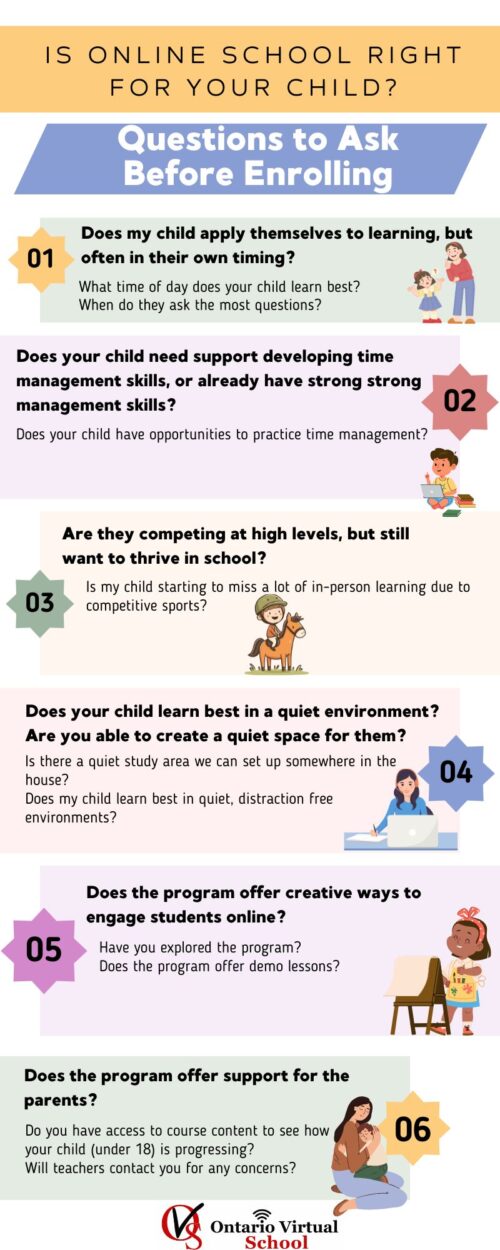
4. Does your child learn best in a quiet environment? Are you able to create a quiet space for them?
In-person learning often means about 24 students in a class with one classroom teacher. Even with great classroom management, it can be hard to achieve an environment with few distractions. It has been shown that a typical classroom will experience 10 to 20 days of instruction time a year (Kraft & Monti-Nussbaum, 2021). Think of an area in your house where you can set up a quiet workspace for your child. No more taking your Grade 7 Science tests (SNC7G) with announcements playing in the background. Virtual learning allows your child to focus on their learning to achieve the best grade, and the most retention possible.
5. Does the program offer creative ways to engage students online?
Not all online programs are equally engaging, so it’s important to choose one that goes beyond reading informational slides and submitting assignments. Ensuring that the program you are choosing not only is accredited, but that they engage students with hands-on learning, is vital. Not only will this keep students interested, but it actually puts into practice their learning. This is especially important with young students. When checking the program you are considering choosing, ensure that they offer demo lessons (a run through of actual lessons in the course). Demo lessons also let you see firsthand whether the program’s teaching style will engage your child. OVS offers demo lessons for all courses, including ICS4U (Grade 12 Computer Science), MHF4U (Grade 12 advanced Functions), FRA6G (Grade 6 Core French), and CHY4U (Grade 12 World History).
6. Does the program offer parent support for online learning?
Research shows that parental support can significantly impact student success. When parents and guardians feel informed and supported, children are more likely to thrive academically and emotionally. As you consider virtual learning, look at whether the program keeps parents engaged and connected.
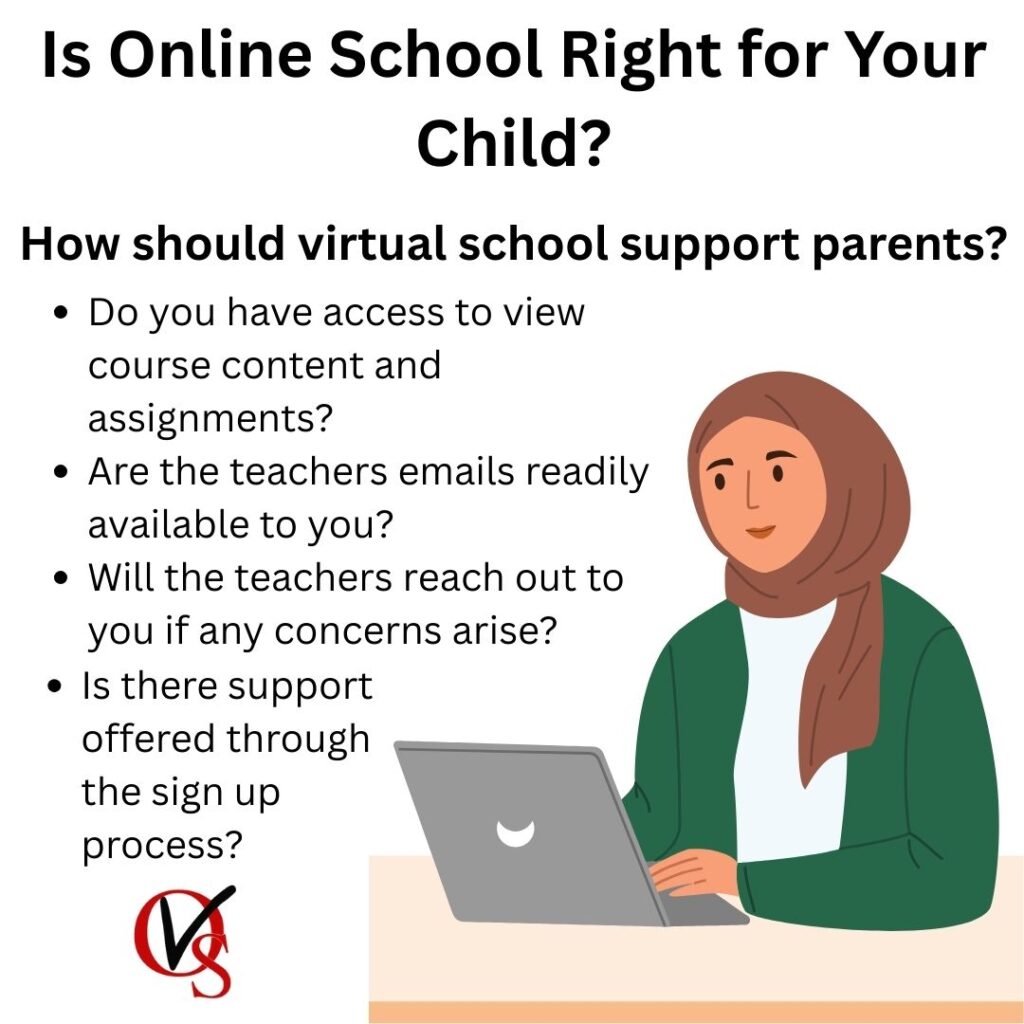
Ask yourself: Will the educators be contacting you if they recognize your child needs support in an aspect of the course? Will you be updated on their performance in class which will help you support them at home? OVS allows you to take a step into your child’s classroom, something that in-person learning can’t do. The best online programs don’t just support the student – they build a partnership with families.
The rise of technology has opened new pathways for learning, but also more decisions for families. Remember that you don’t have to make these decisions alone. Educators not only want to see their students thriving,but also their parents and guardians at ease knowing they made the right decision. Our team at OVS is here to support not only our learners, but also you, the parents and guardians who ensure your child’s success. Check out our website to ensure our program is the right fit for your family.
Q & A
Q1: How is full-time online learning different from the emergency remote learning many families experienced during COVID-19?
A1: Emergency remote learning was a temporary response, while full-time virtual programs are intentionally designed with structured courses, accredited pathways, and virtually trained educators to support students long-term.
Q2: What kinds of students can benefit most from virtual learning?
A2: Online school can be a good fit for children who thrive when working at their own pace, need flexibility to balance academics with extracurriculars like high-level sports, or prefer learning in a quiet, low-distraction environment.
Q3: What 6 questions should parents/guardians ask themselves before enrolling a middle school student in virtual learning?
A3:
- Does my child apply themselves to learning, but often in their own timing?
- Does your child need support developing time management skills, or already have strong strong management skills?
- Are they competing at high levels, but still want to thrive in school?
- Does your child learn best in a quiet environment? Are you able to create a quiet space for them?
- Does the program offer creative ways to engage students online?
- Does the program offer support for the parents?
Written by Katelyn van Hezewyk (OVS Teacher)
Sources:
Kraft, M. A., & Monti-Nussbaum, M. (2021). The big problem with little interruptions to classroom learning. AERA Open. https://doi.org/10.1177/23328584211028856
Mastermind Behavior. (2025, May 25). E-learning/Online Learning Statistics. Mastermind Behavior. https://www.mastermindbehavior.com/post/e-learning-online-learning-statistics-2c4b6?utm_source=chatgpt.com
Pearce, K. (2019, June 25). 100 unconventional quotes about curiosity, learning and education. DIY Genius. https://www.diygenius.com/unconventional-quotes-about-curiosity-learning-and-education/?utm_source=chatgpt.com