
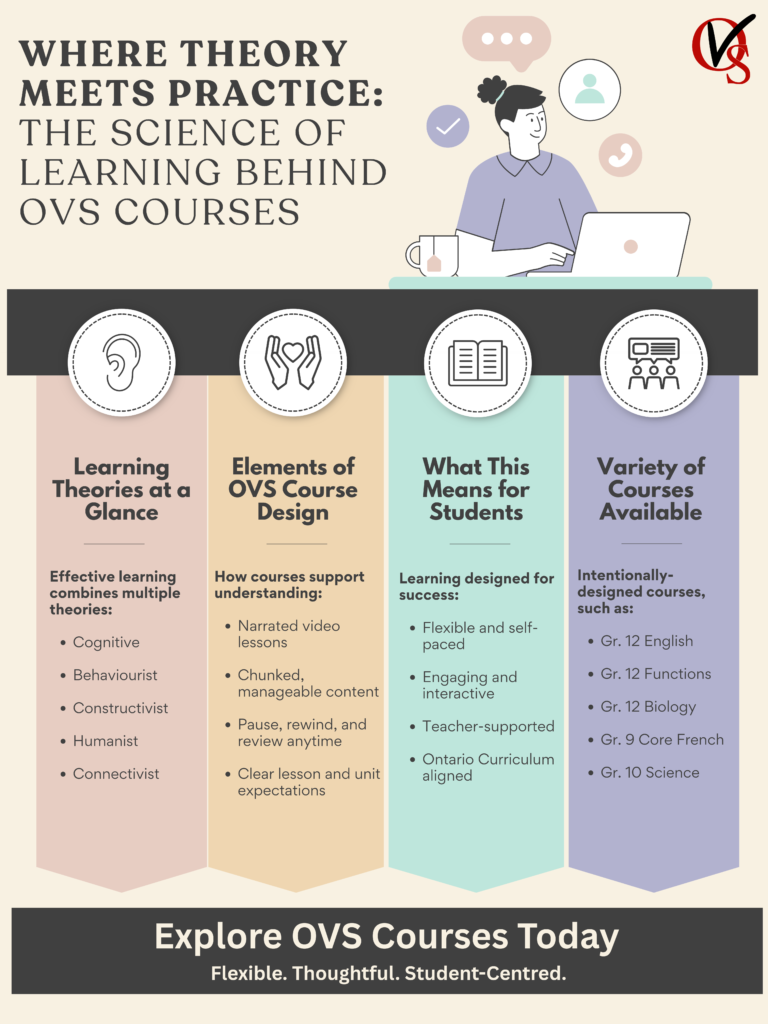
For centuries, experts and thinkers have explored the human mind, developing fascinating theories about how people learn and grow. In the field of education, the 5 most common learning theories are cognitive learning theory, behaviourism learning theory, constructivism learning theory, humanism learning theory and connectivism learning theory. In a classroom setting, these theories work together to help educators ensure that learning is accessible to all students.
Designed with Intention
At Ontario Virtual School, a great deal of thought, planning and expertise has gone into the design of online courses. While the Ontario Curriculum provides the foundational content for all elementary and secondary courses, the OVS design team has ensured that course content is delivered with the learner in mind. As an accredited virtual high school in Ontario, OVS offers Ontario Secondary School Diploma (OSSD) ministry-inspected credits in a wide variety of courses, each of which embody a variety of learning theories.
- Cognitive Learning Theory: Supporting How Students Process Information
Cognitive learning theory focuses on how learners take in, organize, store, and retrieve information. OVS courses, such as Gr. 12 Advanced Functions (MHF4U) strongly align with this theory through intentional lesson design. For example:
- Lessons are delivered through fully narrated PowerPoint videos, helping students process information through both visual and auditory channels.
- Content is chunked into manageable lessons, allowing students to control pace and revisit material as needed.
- Embedded animations, simulations, and videos help students make sense of abstract or complex ideas.
By allowing students to pause, rewind, and review lessons at any time, OVS supports cognitive load management and deeper understanding, which is something that is often difficult to achieve in a traditional, time-bound classroom.
- Behaviourism Learning Theory: Reinforcement, Feedback, and Structure
Behaviourism emphasizes learning through practice, feedback, and reinforcement, all of which are embedded into OVS courses, such as Gr. 12 Biology (SBI4U). This theory underpins many aspects of the OVS model by having:
- Clear lesson sequences and unit structures that help students understand expectations.
- Formative assessments that provide immediate feedback, reinforcing correct understanding and identifying areas for improvement.
- Progression through units and toward a final exam provides clear external motivators and goals.
Overall, rather than relying on impersonal, auto-generated testing, OVS uses teacher-driven assessment. This ensures feedback is meaningful and responsive, which is a more effective form of reinforcement.
- Constructivism Learning Theory: Learning by Doing and Making Meaning
Constructivism learning theory is based on the belief that learners build understanding by actively engaging with content and applying their knowledge. Whether it’s Gr. 9 Core French (FSF1D) or Gr. 12 English (ENG4U), OVS supports constructivist learning through:
- Varied assessment formats such as projects, essays, and video presentations.
- Opportunities for students to demonstrate understanding in ways that align with their strengths.
- Assignments that require application, reflection, and synthesis rather than rote memorization.
Ultimately, by providing choice and voice, OVS allows students to construct knowledge, and not just recall information.
- Humanism Learning Theory: Student Choice, Well-Being, and Personal Growth
Humanist learning theory focuses on the whole learner, emphasizing autonomy, motivation, and emotional well-being, which is a cornerstone of the OVS story. As seen in courses such as Gr. 12 Challenge and Change in Society (HSB4U), students have full control over pace, start dates, and when they engage with learning.
- The model supports students balancing health needs, athletics, employment, or personal circumstances.
- Teachers tailor assessments to student strengths, helping learners feel seen and supported.
- OVS provides strong student success and learning support, reinforcing a caring learning environment.
Generally speaking, by prioritizing flexibility and personalization, OVS empowers students to take ownership of their learning, which is a key principle of humanistic education.
- Connectivism Learning Theory: Learning Through Digital Networks
Connectivism recognizes that learning in the modern world happens through digital tools, online platforms, and networks. In many courses, such as Gr. 12 Computer Science (ICS4U), OVS embodies connectivist principles by:
- Delivering learning through a dynamic, multimedia online platform.
- Encouraging students to engage with digital content, simulations, and online communication tools.
- Connecting students with OCT-certified instructors who guide learning within a global, online context.
Collectively, OVS embraces connectivism learning theory by supporting learners from around the world, reflecting the interconnected nature of modern education.
Explore Courses Now
If you’re looking to experience first-hand how OVS courses are thoughtfully designed with the learner in mind, check out our wide range of course options or reach out to a Guidance Counsellor today for more information.
|
Frequently Asked Questions What makes Ontario Virtual School courses unique? Are OVS courses aligned with the Ontario Curriculum? Can students work at their own pace? What types of assessments are used? Do students receive teacher support? Is online learning effective for challenging courses? Who is OVS a good fit for? How do I get started? |
Sources:
Pace, K. (2025, June 23). Five Educational Learning Theories. Western Governors University. https://www.wgu.edu/blog/five-educational-learning-theories2005.html
Written By Natalie Tayler (OVS Teacher)