

Boost Focus and Beat Burnout: Brain Breaks Aren't Just for Kids
You’re staring at your Grade 12 Advanced Functions course (MHF4U), the words and numbers are blurring together, and you’re pretty sure you’ve already read that last sentence, twice. Sound familiar? Studying is essential, but it doesn’t need to be painful. Some methods support your brain, while others can lead to burnout. At Ontario Virtual School, we’re here to help you learn study tips for online high school, and yes, that includes brain breaks, because who doesn’t love those? But before you toss your books aside and start scrolling, let’s define what a brain break is.
According to NSW Education (2023), “a brain break is a simple physical or mental exercise” designed to refresh your focus. These short, purposeful activities help rebalance neural activity and combat mental fatigue, which is something your social media feeds can’t provide. Extended study sessions can wear down your prefrontal cortex (the part of your brain responsible for concentration and decision-making) causing it to fatigue. A well-timed and structured brain break helps reset that region and restore your ability to concentrate (Willis, 2023). Even if it is only a brief pause, it helps shift your attention inward and re-energize your brain (NIH, 2021).
Brain Breaks Aren’t Just for Classrooms
Teachers have long known the value of brain breaks and they’re a regular part of in-person learning. What some fail to realize, is that for the world of online education and adult education, they’re just as crucial. At our accredited online high school, we don’t just deliver a comprehensive curriculum, but we also support the whole learner. This includes teaching effective online learning study habits that will benefit you throughout your education and beyond. So, what does an effective brain break look like in online learning environments? There are two key elements to an effective brain break: timing and activity.
Timing
When it comes to effective brain breaks, timing is important. Timing refers not only to how long the brain break is, but when you should take it. While everyone is different, a general rule of thumb to follow is for every 20 to 30 minutes of studying, take a three-to-five-minute brain break (Tutt, 2023). If you feel you can go for 40 minutes, study your CLN4U (Canadian and International Law course) for 40 minutes then take a 10 minute brain break, just enough time for a walk! With our self-paced high school, you don’t have to worry about strict deadlines, you can focus on doing your best in OLC4O (Ontario Literacy Course), or whatever course you may be in, and succeeding without the rush.
Activity
Unlike the group games you’d find in a classroom, brain breaks for online learners are often solo activities. But that doesn’t mean they are boring! There are countless options that will help you stay motivated in online high school. Try the following:
- A walk: Walking has been shown to improve your mood, sleep quality, energy levels and stress, all of things that fuel better learning (WebMD, 2024).
- Yoga: No need for a personal instructor, YouTube has countless videos. Try this video by “Yoga with Adriene”.
- Music: Listening to songs that make you feel good can boost your motivation. Bonus points if you can dance for an added body break. If you are not comfortable freestyle dancing, try finding a follow along video on YouTube! “Madfit” has fun dance workouts that will wake you right up!
- Pro tip: While working on CPW4U (Grade 12 Canadian and International Politics), try listening to calming study music with no lyrics
- Puzzles: Whether it be a puzzle with pieces or just a problem for your brain to solve, like a crossword or word search, puzzles can enhance your mood by releasing dopamine, which “regulates mood, memory and concentration” (Progress Lifeline, 2023).
- Clean up: Whether this be your workspace, room or the house, put on some good music and a timer and start cleaning.
Why is this a skill and not just a good habit?

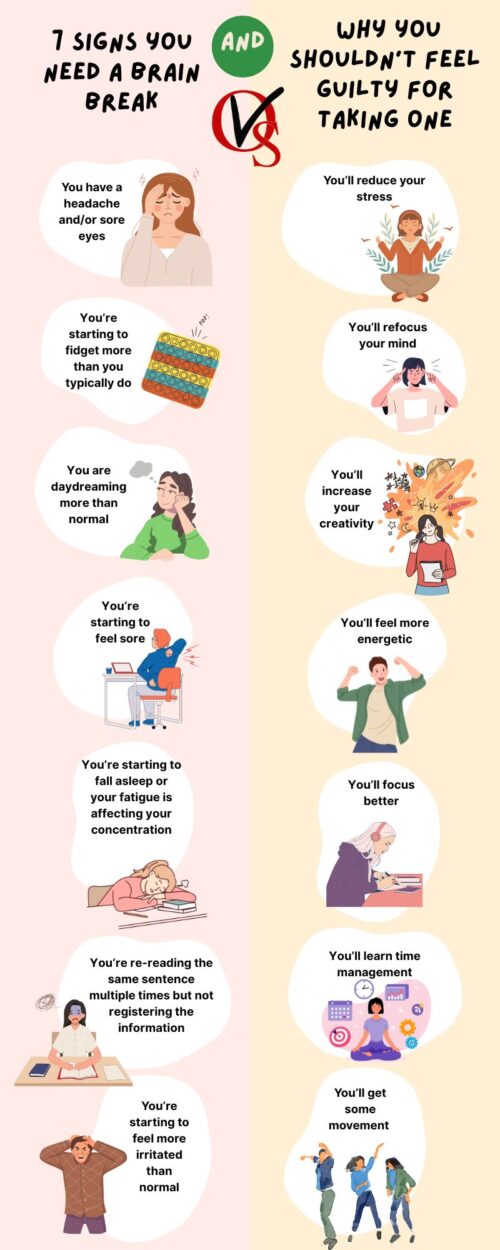
Brain breaks are not only a great tool for study sessions; they also contribute to increasing your self-awareness. Recognizing when you need a break can lead you to discover what time you can focus best in the day, and what kinds of study breaks work best for you. Below are some indications that it may be time for a brain break:
- You’re having to re-read the same sentence over and over but not registering the words
- You’re starting to fall asleep or your fatigue is affecting your concentration
- You’re starting to feel sore
- You are daydreaming more than normal
- You’re starting to fidget more than you typically do
- You have a headache and/or sore eyes
- You’re starting to feel more irritated than normal
Don’t Feel Guilty - Step Away for a bit to Succeed
Taking a brain break does not have to mean procrastination, it can be smart learning! When used intentionally, brain breaks don’t just help you refocus in the moment, they also strengthen your long-term learning habits.
Some wonder, “Is online high school effective?” The answer is yes, especially when you develop skills like time management, self-awareness and balance. Taking breaks is one of those skills. So go ahead, lace up your runners and go for a walk, your learning (and OVS) will be there when you get back.
Written by Katelyn van Hezewyk (OVS Teacher)
Sources:
National Institutes of Health. (2021, June 8). Study shows how taking short breaks may help our brains learn new skills. https://www.nih.gov/news-events/news-releases/study-shows-how-taking-short-breaks-may-help-our-brains-learn-new-skills
NSW Department of Education. (2023, March 23). Brain breaks for cognitive wellbeing. https://education.nsw.gov.au/schooling/school-community/wellbeing-framework-for-schools/cognitive-wellbeing-strategies/brain-breaks-for-cognitive-wellbeing
Progress Lifeline. (2023, January 27). The benefit of puzzles for the brain. https://www.progresslifeline.org.uk/news/the-benefit-of-puzzles-for-the-brain/
Tutt, P. (2023, September 1). 17 brain breaks tailored for high schoolers. Edutopia. https://www.edutopia.org/article/17-brain-breaks-tailored-for-high-schoolers/
WebMD. (2024). Health benefits of a morning walk. https://www.webmd.com/a-to-z-guides/health-benefits-morning-walk:contentReference[oaicite:2]{index=2}
Willis, J. (2023, December). The neuro-logical power of brain breaks for best learning. RadTeach. https://radteach.com/styled-15/styled-35/index.html
https://www.webmd.com/fitness-exercise/mental-benefits-of-walking
https://www.cdc.gov/physical-activity-basics/benefits/index.html