
Being unsure of what your post-secondary goals are can be overwhelming, especially when it’s time to start applying. Hearing friends confidently discuss their plans for when they finish high school online can add pressure. Many students feel that by the age of 18, they should know the career they will pursue for the rest of their lives.
In reality, not knowing what you want to do is completely normal, and can even be a good thing. Being unsure means you have options, and that’s a wonderful thing! At Ontario Virtual School we have supported over 18,000 students through post secondary decision-making. While the path you choose is ultimately up to you, we are here to provide you with the information and guidance needed to help you make a confident, informed decision.
Here are four options to consider when you are unsure of your post-secondary plans:
1. Start with what you know
At the end of the day, you want a career that feels meaningful, aligns with your values, and brings you joy. Taking time for self-reflection can help you explore areas that may lead to fulfilling academic and career paths. It also ensures that you’re choosing a direction for yourself, rather than trying to meet others’ expectations.
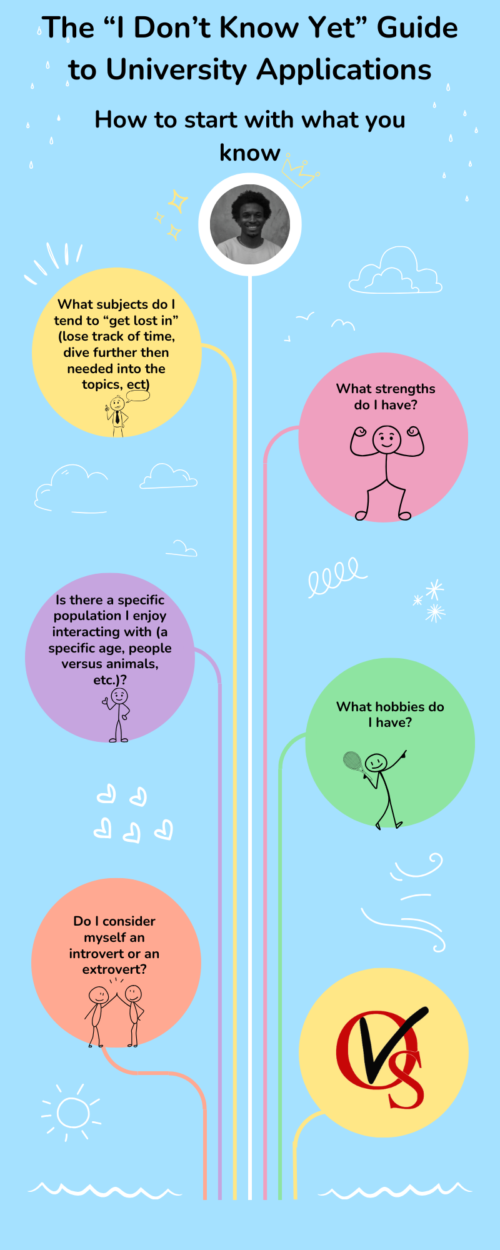
Here are some helpful guiding questions to consider:
- What subjects do I tend to “get lost in” (lose track of time, dive further then needed into the topics, ect)
- Losing track of time while studying suggests an area worth exploring further. For example, if you find yourself researching fun facts about the brain after studying HSP3U (Grade 11 Anthropology, Psychology and Sociology), Psychology may be a great option. Many general Arts or Science programs allow you to focus on Psychology, and from there, you will learn about careers in that field. With over 170 courses to choose from, your interests are bound to be sparked in a course with OVS.
- Do I consider myself an introvert or an extrovert?
- Both personality types offer countless career options. For example, careers in software development may require less emphasis on extraversion whereas a teacher requires frequent interactions with others.
- Is there a specific population I enjoy interacting with (a specific age, people versus animals, etc.)?
- Some people naturally gravitate toward children, teens, seniors, animals, or those in specific life circumstances. If you enjoy working with animals, you could explore veterinary-related fields. If younger kids aren’t your passions, you may thrive teaching high school or working with adults.
- What hobbies do I have?
- Even if your childhood dreams aren’t your career goals anymore, your interests still matter. Bring back those dreams, and look at them from a different lens. For example, athletic interests may translate well to physiotherapy or sports management while musical interest could translate to something related to sound design.
- What strengths do I have?
- Strengths are not just technical skills, personality traits are important too. Being determined, strong-willed, or confident might translate well in the field of law. Consider your personality and look for careers where these traits are valued.
2. Take your time (just don’t miss the OUAC or OCAS deadlines if you do plan to enroll for September!)
It often feels like a race, but milestones in life don’t feel any less special due to your age. Whether you decide what you do now, or in a year or two from now, your accomplishments will be just as special. Taking a gap year can be a valuable way to explore interests, save money, upgrade courses, and gain real-world experience. These experiences often spark ideas for career aspirations.
You are not alone if you decide to take time to think your options through, Ferrer and Menendez (2014) found that about 24% of students delayed their post-secondary enrollment.This is valuable time to think more about your future goals and possibilities,
There are several options to consider during a gap year, and choosing which works best for you depends on individual circumstances. Below are some options to consider:
- Work
- Earn money to reduce financial stress and gain hands-on experience.
- Travel
- Encourages personal growth, boosts communication skills, increases creativity, and builds cultural awareness.
- Take high school courses
- Taking OVS high school courses allows you to explore your new subjects, earn additional credits, or improve marks. With an online format, you can work while balancing school to set yourself up for success with whichever path you decide. With a large variety of courses to explore your interests, such as World Issues (CGW4U) to Grade 12 Chemistry (SCH4U), you are bound to uncover a new interest.
- Develop personal skills
- Volunteer
- Volunteering benefits your community, builds confidence, and strengthens applications for jobs, colleges, and universities. Look in your area to see what opportunities are available and the ones that interest you the most. Chances are, you already have a good starting point in regards to interests in volunteering, due to the 40 volunteer hour requirements in Ontario to obtain an OSSD.
- Become an entrepreneur
- Your skills and interests may translate into a unique business!
3. Choose a flexible path
There are plenty of post-secondary programs designed for students who haven’t chosen a specific career yet. General programs explore the subject and help build skills that often accompany careers under this subject. Think about the courses that you took with OVS, what subjects did you enjoy that you could continue with into a general degree at a university?
A Bachelor of Science in Mathematics can develop your analytical and problem-solving skills which can later help you as a financial analyst, accountant, teacher, engineer, to name a few. Below are some more general programs to consider:
The beauty of these general programs is that you have options and time to decide!
4. Connect with others
Look around your community! You are surrounded by people who have faced or are making the same decision that you’re navigating now. Speaking with friends, family and community members can offer you insight. Discussing your options with an unbiased party, such as a therapist, may help as well to gain a nuanced perspective. Remember that OVS is your community as well. Check out our student spotlights to explore some career paths that our past and current students have/are taking. Our guidance team can also help you navigate these questions as you inquire about courses. We offer meet times dedicated to helping you achieve your career goals, even if they are still open for a decision!
Not knowing your career goals does not mean that you are falling behind. There are plenty of options, and OVS is here to help you every step of the way. Each staff member at OVS has been through this decision as well and. We are your community that you can connect with for support! Reach out to us today, we are here for every step in your education journey!
Q & A:
What should I do if I don’t know what I want to study after high school?
Answer:
Not knowing your future career at 17 or 18 is completely normal. Start with self-reflection—think about what subjects you enjoy, your personality traits, your strengths, and the types of people or environments you prefer working with. These clues can help point you toward meaningful program options without needing to have your entire future planned.
Is it okay to take extra time before starting post-secondary?
Answer:
Yes! Many students take a gap year to explore interests, work, travel, volunteer, upgrade courses, or develop new skills. About 24% of students delay post-secondary enrollment, and the experience can help you gain clarity about your goals while reducing stress or financial pressure—just be mindful of OUAC/OCAS deadlines if you plan to start the following fall.
What are some good options if I still don’t have a clear career path?
Answer:
Choose flexible programs or seek guidance from others. General degrees—like a Bachelor of Arts, Bachelor of Science, or Sociology—give you time to explore different subjects. Talking with family, friends, mentors, or OVS guidance counselors can also help you discover options that match your interests. You’re not behind—there are many paths, and support is available at every step.
Written by Katelyn Van Hezewyk (OVS Teacher)