

The idea of the university is far from new. It dates back to the Middle Ages, when some of the world’s first centres of higher learning took shape in cities like Paris, Bologna, Montpellier, Oxford, and Salamanca. Closer to home, the oldest institution of higher learning in Canada dates back to 1663, with the Université of Laval having been founded by the Séminaire de Québec. Since that time, the desire for higher learning has flourished. Today Canada currently has 97 public universities with over 16,000 university programs to choose from. What is more, 9 Canadian universities are in the top 200 in the world, including 4 in the top 100!
Preparing for University with OVS
With so many choices – both within Canada and abroad – it’s no wonder that students often feel overwhelmed when researching and applying to universities. While there are many steps in the application process, one of the first steps is ensuring that students have the requirements to graduate high school and receive their Ontario Secondary School Diploma (OSSD).
At Ontario Virtual School, we offer many courses that students require to graduate and also apply to university.
- For example, to graduate high school in Ontario, students must complete specific compulsory credits, such as Gr. 9 French (FSF1D) or Gr. 10 History (CHC2D).
- When planning to apply to university in Ontario, students also need to have at least 6 4U/M courses. At OVS, students can work towards this requirement by completing an online course such as Gr. 12 English (ENG4U) or Gr. 11 Functions (MCR3U).
- Lastly, students need to ensure that they have the required prerequisite courses for their program of choice. For example, in order to pursue studies in Biology, students will also need Gr. 12 Biology (SBI4U).
Now Comes the Hard Part
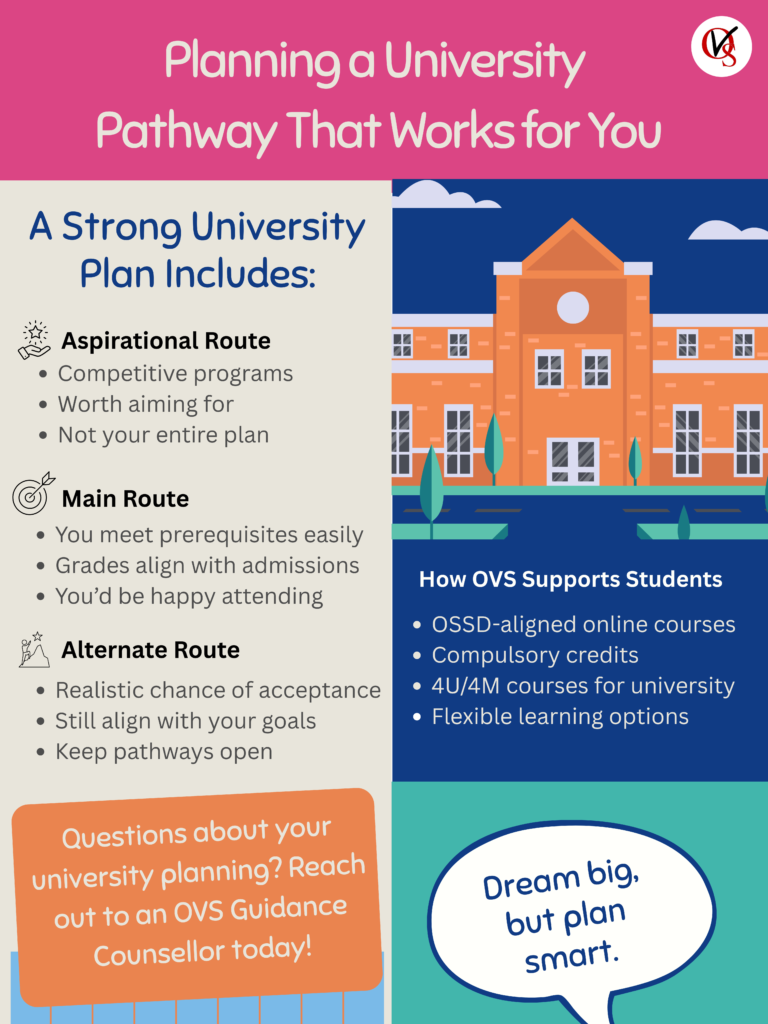
In some ways, completing the requirements is the easy part. It’s choosing the universities and coming up with a plan that can often be more challenging. Many students focus too much on their “dream” school – the school that will check off all the boxes and be the perfect fit. While it’s important to have goals and to aim high, it’s equally important to not put ‘all your eggs in one basket’, so to speak. Students also need to have a back-up plan – a plan that is still exciting and meets their needs, but might also be more realistic. The steps below can help families create a plan for your university journey that is both comprehensive and practical:
→ Step 1: Choose Your Aspirational Destinations
These are the places you dream about visiting. They’re exciting, competitive, but sometimes hard to get to. They’re absolutely worth putting on your map. But they can’t be the only places you plan for because these programs often have very low acceptance rates. If your entire route is made up of dream destinations, you don’t have a plan – you have a wish.
→ Step 2: Map Out Your Main Route
This is the heart of your journey and truthfully the route you’re most likely to take. These are programs where you meet the prerequisites comfortably, your grades and experiences align with typical admitted students and you would genuinely be happy studying there. Most students and families should spend the most time here, because this is where outcomes are most predictable and satisfying.
→ Step 3: Plan Your Alternate Routes
This is where many students get stuck. An alternate route is not: “A random school I don’t actually want”; “Whatever is left” or “The closest option, just in case”. A real alternate route is a program you’d still genuinely attend with a realistic chance of admission and one that still keeps you moving toward your long-term goals. For example, this might be a different campus, a slightly less competitive version of the same program, a related program that keeps future career paths open or a pathway or transfer-friendly option.
→ Step 4: Do a Final Route Check
Sit down together and ask: “If my first choice doesn’t work out, would I still feel excited about my next options?” If the answer is no, your route needs adjusting. Good planning isn’t about avoiding uncertainty. It’s about being ready for more than one successful outcome and avoiding ‘putting all your eggs in one basket’.
FAQs
How many universities are there in Canada?
Canada has 97 public universities, offering more than 16,000 programs across the country. With so many options available, finding the right fit often takes thoughtful planning.
How many universities should a student apply to?
Most students benefit from a balanced list that includes a few aspirational choices, several realistic options, and at least one or two strong backups they’d be happy to attend.
What courses do students need to apply to university in Ontario?
Students must earn their Ontario Secondary School Diploma (OSSD), complete six Grade 12 U or M courses, and meet the specific prerequisite requirements for their chosen program.
Can online courses count toward university admission?
Yes. Online courses from an inspected private school, such as Ontario Virtual School, count toward OSSD requirements and are recognized by Ontario universities.
Written by Natalie Tayler (OVS Teacher)