
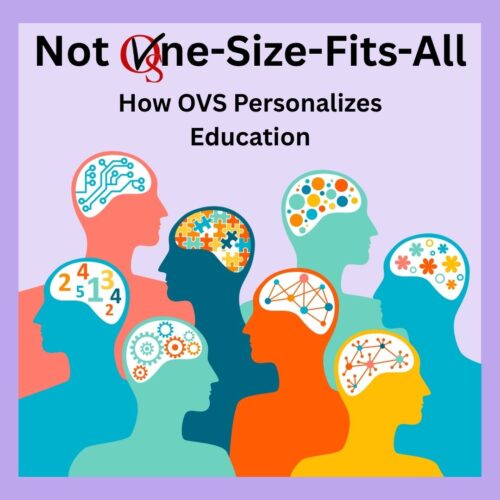
Not One-Size-Fits-All: How Ontario Virtual School Personalizes Education
Imagine walking into a classroom where every student is expected to learn the same way, at the same pace, using the same method. Now think about your classmates, friends, and family – each one of them learns differently. So why should education be a one-size-fits-all approach? Yes, the response to a math question may only allow 1 response, but each person learns and remembers the steps in their own way.
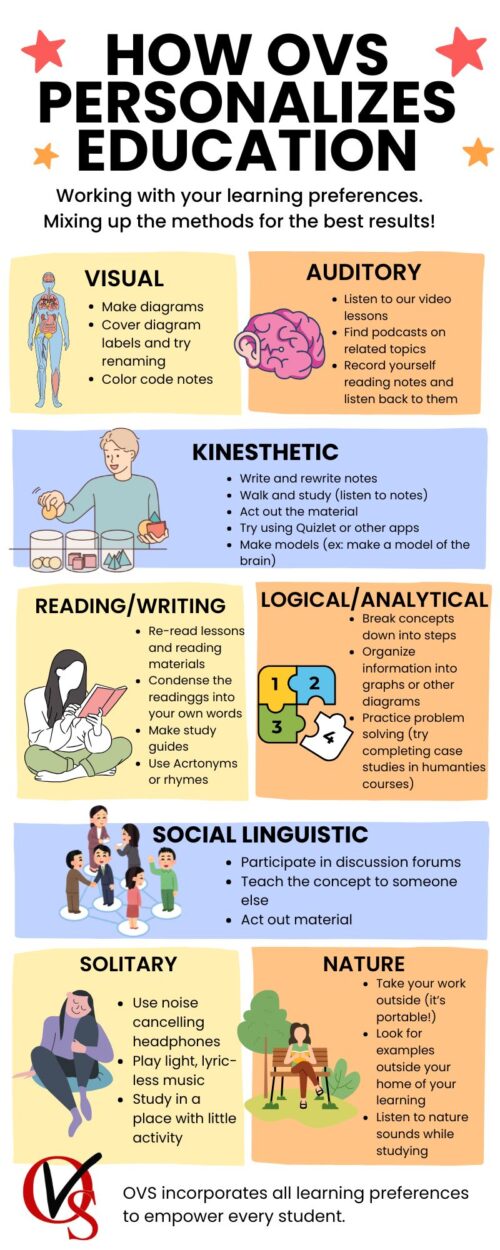
Differences in learning are shaped by our individual experiences, preferences, memories, and even the structure of our brains. The brain is a magnificent and complex organ that plays a central role in how we learn. For decades, educators and researchers have explored these differences, some supporting the theory of seven distinct learning styles (physical, solitary, verbal, visual, aural, logical, and social), while others question its validity. However, it’s clear that understanding the factors that influence learning can lead to more effective and inclusive education.
How OVS Empowers Diverse Learners
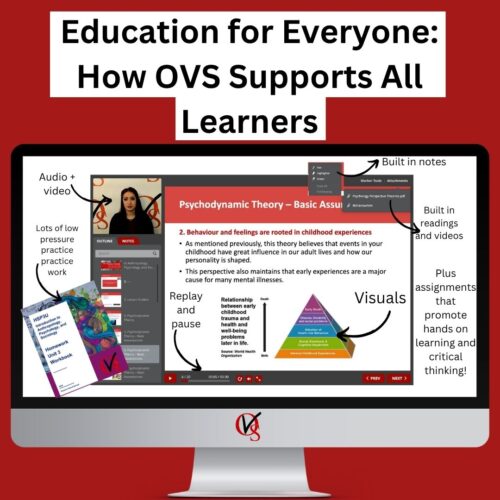
Ontario Virtual School recognizes that no two learners are the same, and we offer an array of features within our courses to cater to different learners. Gone are the days of passively listening to a teacher read from a textbook. With OVS, students can pause and replay material, view content in both visual and written formats, and listen to lessons. This variation in lesson formatting ensures students remain engaged and understand the material deeply. This reflects the idea that while accommodations are essential for some, they benefit all. Our website allows you to experience demo lessons, where you can see a glimpse of some of these features, such as in Grade 12 Data Management (MDM4U).
Our private online high school proves that differences in learning aren’t just theoretical, they shape how we design and deliver our courses, and for our students with Individualized Education Plans (IEPs), this flexible and responsive model is even more powerful. Many of the most common IEP accommodations (use of visual aids, step-by-step directions, use of audio, extra time for processing information, extra time to complete assignments, and pre-teaching vocabulary), are intentionally embedded in our multi-modal course structure to reflect and support all students. Additionally, our team of dedicated educators ensures that when students send their IEPs, they are passed to our teachers to help every learner thrive.
What is an IEP?
An IEP, or an “Individualized Education Plan”, is a written plan that describes services that the school board will provide for a student (Ontario Ministry of Education, 2022). While private schools in Ontario aren’t required to follow IEPs, OVS proudly honors them to “empower all learners so they can experience academic success”. Part of this process includes recognizing that every student learns differently. An IEP allows teachers to better understand individual students learning habits, and how we can help them succeed in their course. If you have an IEP, we encourage students to send it to [email protected] so your instructors keep your individual learning needs in mind. Our commitment to empower all learners doesn’t stop at students with IEPs, it benefits every learner.
Inclusive Learning by Design
Our multimodal course design is rooted in the principles of Universal Design for Learning (UDL), which encourages flexible methods of teaching to accommodate diverse learning needs. This style of learning helps students “create more integrated memories” (Mathias, 2023). We put this into practice, truly highlighting the benefits of online high school. Within courses at OVS, students will have access to videos that can be replayed, visuals that relate to the course material, and assignments that include hands-on learning. For example, students taking HSP3U (Introduction to Anthropology, Psychology and Sociology) will learn about multiple theories within these fields. In exploring these theories, they will be supported by visuals that enhance understanding, and they will be asked to apply them to their own lives in assignments. Students have opportunities to connect with their peers in conversations about course content, and bring all of these methods together to develop their critical thinking skills.
Going Forward
With our inclusive approach to education, the possibilities are endless. No student should be limited because of the way they learn, or due to their learning preferences. Our students, such as Paige Waddell who hopes to graduate early with us, appreciate the multi-model learning that OVS offers, and the care we put into our courses. As OVS continues to innovate in education, our goal remains clear: to provide a learning environment where every student feels supported, empowered, and capable of success. We are here to remind you that your opportunities in this world are endless, and we want to provide you with the knowledge that will allow you to unlock this potential. Why choose online high school? Our courses reflect the differences between each learner, and how recognizing your strengths in how you learn will take you far!
Written by Katelyn van Hezewyk (OVS Teacher)
Sources:
Bay Atlantic University. (2024, March 7). 8 Types of learning styles | The Definitive Guide. BAU Blog. Retrieved June 7, 2025, from https://bau.edu/blog/types-of-learning-styles/#:~:text=One%20of%20the%20popular%20theories,a%20predominant%20style%20of%20learning
Cornell University Center for Teaching Innovation. (n.d.). Universal design for learning. Retrieved June 7, 2025, from https://teaching.cornell.edu/teaching-resources/universal-design-learning
Government of Ontario. (2022, August 16). Individual education plans. https://www.ontario.ca/page/individual-education-plans
Mathias, B., & von Kriegstein, K. (2023). Enriched learning: Behavior, brain, and computation. Trends in Cognitive Sciences, 27(1), 81–97. https://doi.org/10.1016/j.tics.2022.10.007