

Making the Most of your Education: Choosing Courses That Interest You
Seniors, stop reaching for the “bird courses”
Remember the first time you got to choose your own courses? There was a lot of talk about choosing between visual arts, drama and music. These early choices can say a lot about a student’s interests, attention to detail and their level of introversion versus extroversion. However, after grade 9, students often shift their focus on the courses they need for their post-secondary goals. While this is very important (and necessary), students often overlook courses that they are interested in.
The benefits of taking courses that genuinely interest you can extend beyond high school. So before locking in your course selection with Ontario Virtual School, consider the advantages of choosing a course because it excites you! There are countless virtual high school courses to choose from, stemming from multiple topics of interest!
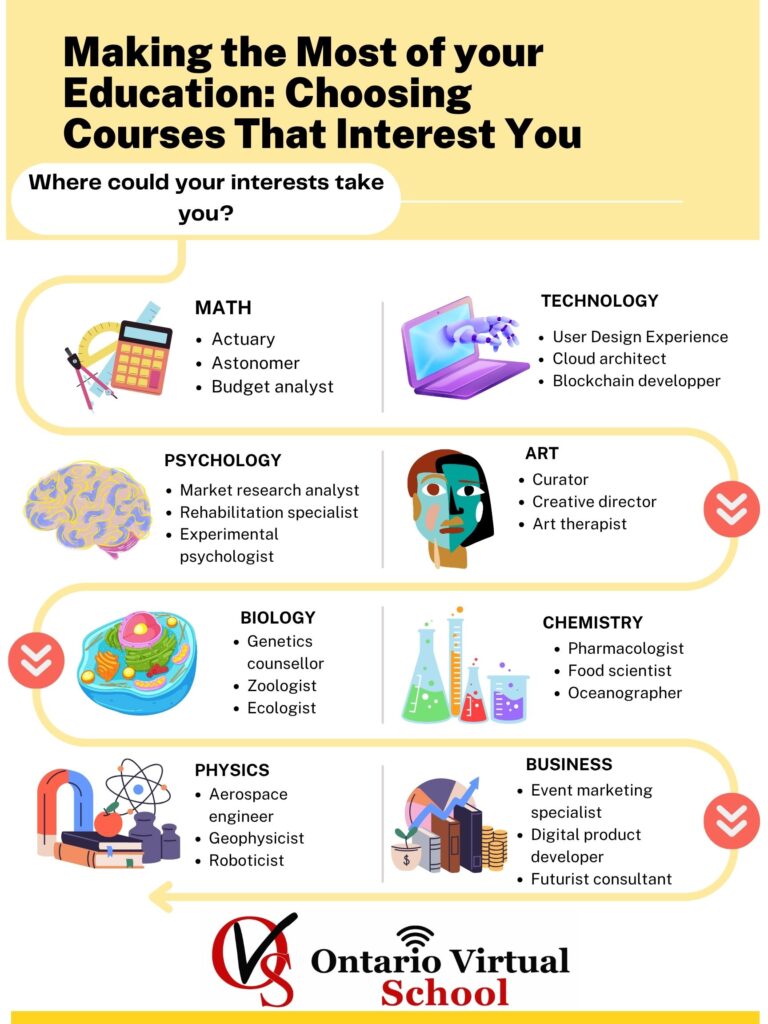
1. Learn about careers that are not “typical”
Are you interested in psychology and art?
User Experience (UX) Designer/Researcher: Study how people use and enjoy digital products
Are you interested in art and psychology?
- Art Therapist: Help clients through artistic expression
- Look into:
Are you interested in protecting the planet and space?
- Planetary Protection Specialist: Ensure spacecrafts don’t contaminate other planets
- Look into:
Are you interested in technology and ethics?
- Robotics ethicist: Examines moral questions surrounding AI
- Look into:
2. Achieve higher marks
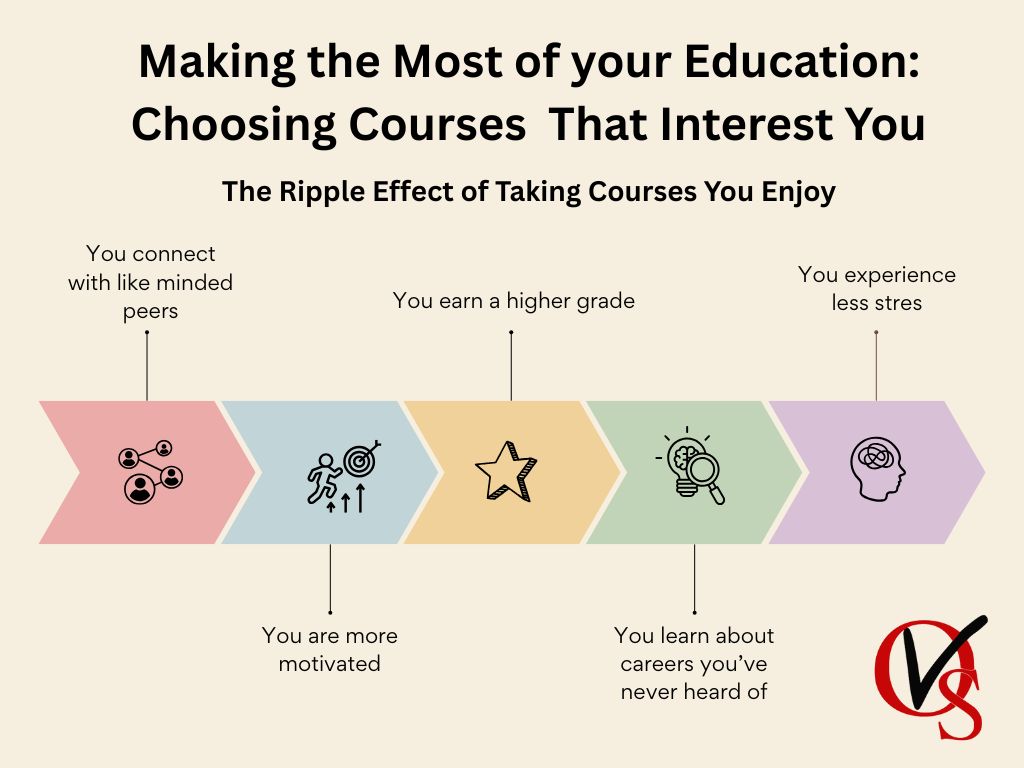
Think about how much easier it is to get up in the morning when you’re about to do something you enjoy. School is the same. When you like the subject, it’s much easier to motivate yourself to do the work. This motivation will naturally lead to a stronger focus, more effort, and often, better grades. The university acceptance from your online high school will naturally come from this!
Intrinsic motivation is motivation that comes from genuine interest or enjoyment,and is an extremely powerful tool that students should be taking advantage of. As a teacher, I often see senior students choosing courses that they deem easy so they can increase their average for university applications. However, they often overlook the power of intrinsic motivation that can be derived from the course content.
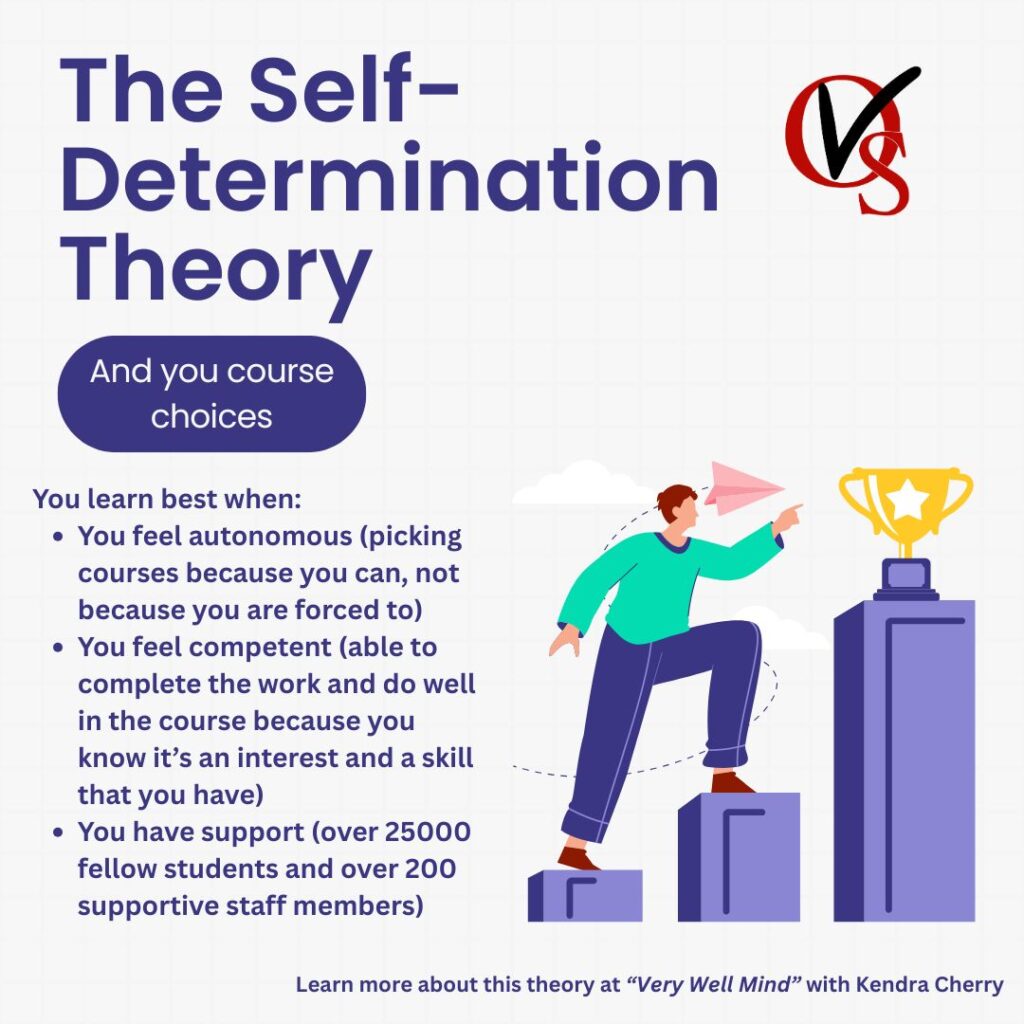
This idea connects to the Self-Determination Theory, which explains that people learn best when they feel autonomous (in control of their choices), competent (capable and confident), and connected (supported by others) (Cherry, 2024). Those who use intrinsic motivation are taking advantage of the Self-Determination Theory. The Self Determination Theory gives people the feeling that they have control over their life and the outcomes.
3. Connect with others
The foundation of many friendships is shared interests. When two people are passionate about the same topic, conversations come naturally (and can go deeper than small talk) and there’s a greater chance you’ll connect again in the future. Shared interests not only spark discussions, but also increase the likelihood of meeting people with similar values and goals through clubs and courses.
Teachers don’t include discussion forums in courses for nothing! Discussions provide the perfect opportunity to connect with others who share similar interests. By taking a course that genuinely interests you, you’re more likely to meet like-minded peers. These connections can continue beyond the course, especially if you pursue related courses or careers.
4. Less stress
Taking control of your course choices as opposed to feeling “forced” to take certain subjects for future goals can significantly reduce stress. By engaging in a topic you are interested in, you’re more likely to stay engaged and motivated, which helps break anxiety loops that may occur while studying. Curiosity about subjects keeps your mind focused and provides a healthy distraction. It’s also easier to enter a calm, focused state when you’re learning about something that naturally interests you.
There is research that supports the connection between interest and stress. Perng et al. (2019) found that nursing students in Taiwan experienced higher stress levels in their clinical practicum placements when they had lower interest in nursing. In other words, feeling interested and invested in what you study intrinsically can directly protect your mental well-being. Furthermore, taking courses you are interested in may lead to a new hobby, and extracurricular activities for online students have been shown to reduce stress.
Spark your curiosity
The value of taking courses that interest you extends far beyond a four week to twelve month course. One of the biggest tips for online high school success that educators can give is to enroll in courses that interest you (when you can). Your interests make you unique, and they should be explored. Don’t just take courses to check boxes or because they seem ‘easier’ – choose ones that spark curiosity. With over 170 courses, Ontario Virtual School has a course just for you. It may be life changing!
Frequently Asked Questions (FAQ)
Q1: Why should I choose courses that genuinely interest me instead of “bird courses”?
A1: Courses that match your interests boost your motivation, focus, and enjoyment. This often leads to better grades and reduced stress. Plus, you’ll feel more engaged in learning.
Q2: Can taking interesting courses still help with university or career goals?
A2: Absolutely. Exploring courses that excite you can uncover unique career paths and give you an advantage in specialized fields. Passion-driven learning can also strengthen your post-secondary applications.
Q3: How can choosing interesting courses reduce stress?
A3: When you’re genuinely curious about a subject, studying feels less like a chore. This engagement helps lower anxiety, improves focus, and promotes overall well-being.
Resources
Cherry, K. (2024, July 18). Self-determination theory: How it explains motivation. Verywell Mind. https://www.verywellmind.com/what-is-self-determination-theory-2795387
Government of Canada. (2025, September 16). Career quiz: Interests. Job Bank. https://www.jobbank.gc.ca/workpreference
Government of Ontario. (2025, October 19). Learn about colleges, universities and Indigenous institutes in Ontario. https://www.ontario.ca/page/learn-about-colleges-universities-and-indigenous-institutes-ontario
NASA Office of Safety and Mission Assurance. (n.d.). Planetary protection. NASA. Retrieved October 19, 2025, from https://sma.nasa.gov/sma-disciplines/planetary-protection
Perng, S.-J., Sung, H.-C., Chen, C.-J., Lee, T.-Y., & Koo, M. (2020). Low interest in clinical practicum placement is associated with increased stress in nursing students in Taiwan: A cross-sectional survey study. Nurse Education Today, 84, 104241. https://doi.org/10.1016/j.nedt.2019.104241
University of Ottawa. (n.d.). Canadian Robotics and Artificial Intelligence Ethical Design Lab (CRAiEDL). Centre for Law, Technology and Society. Retrieved October 19, 2025, from https://www.uottawa.ca/research-innovation/centre-law-technology-society/labs/craiedl
Zeidan, M., Ballout, R., Al-Akl, N., & Kharroubi, S. A. (2025). Exploring the relationship between extracurricular activities and stress levels among university students: A cross-sectional study. PLOS ONE, 20(8), e0329888. https://doi.org/10.1371/journal.pone.0329888
Written By Katelyn Van Hezewyk (OVS Teacher)