
Reading 100 Ways to Change your Life felt like sitting down with a wise older sibling who just wants to see you succeed. At Ontario Virtual School, strive to be a supportive guide for our students. We’re always looking for practical tools that can make online learning smoother and help students achieve their goals. This book is packed with great life timbits that can be connected to your studies at OVS and used as online learning tips for high school, so we wanted to give you a part two!
Online school lets you study anywhere and at any stage of life, but we know that there are also challenges with online high school. The good news is that these challenges can become valuable study habits and even life lessons. Whether you’re struggling to manage your time, to keep your energy up, or to avoid procrastination in online classes, you’ll find a strategy here to help you thrive.
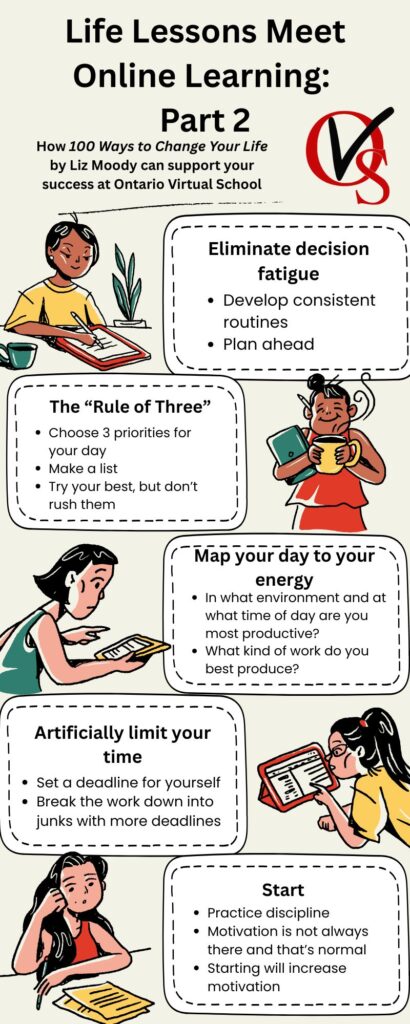
Eliminate Sources of Decision Fatigue (Chapter 17)
From the moment you wake up to the time you fall asleep, you make about 35,000 decisions a day (Moody, 2023, p. 61). Overwhelming, right? Enrolling in an online course is a smart step for your future, but it can also add more choices to your day – when to study, what to work on first, and how to plan your time.
Reducing some of these small, repetitive decisions can “off-load the cognitive processes behind menial tasks”, freeing up mental energy for what matters most (Moody, 2023, p. 62). For example, instead of deciding what to eat every day, meal prep your lunches for the whole week. Or create a consistent evening routine so you don’t have to decide each night when to turn the TV off or whether to read before bed. Over time, these small habits can become automatic, saving your energy for your studies, and turning into routines that you’ll keep for years.
Create a Rule of Three (Chapter 19)
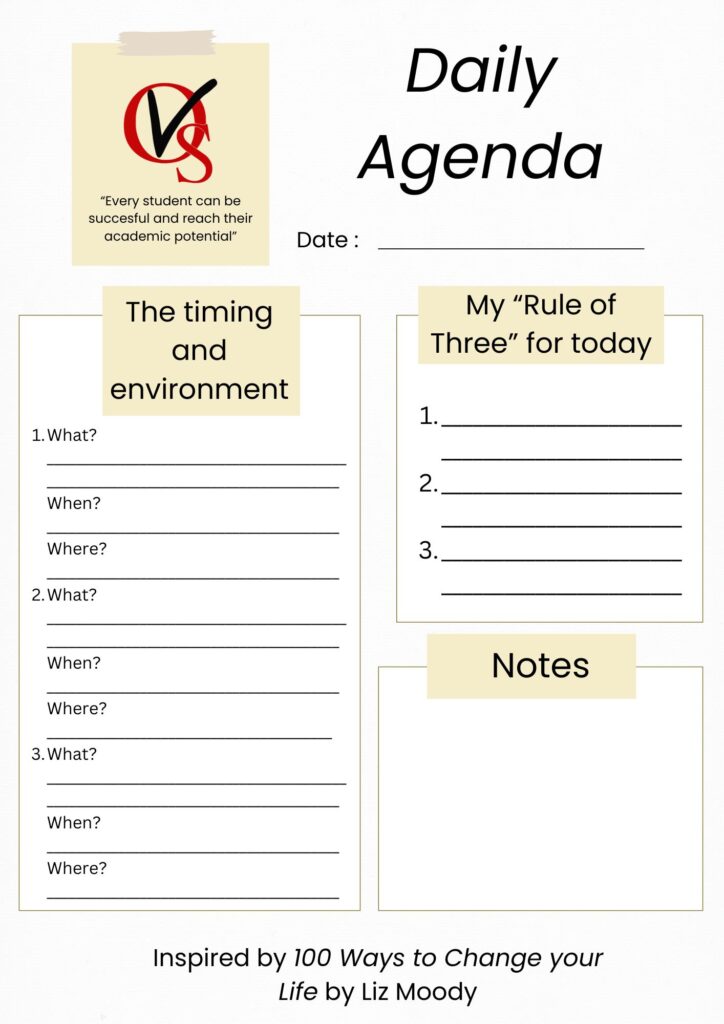
There is one decision we’d like you to make each morning: choose your “rule of three”. As Moody (2023) suggests, ask yourself “What three main things do I want to accomplish today?” Focusing on just three priorities helps you structure your day and avoid feeling overwhelmed.
If you don’t finish everything, don’t stress. These goals can roll into tomorrow (one less decision for tomorrow!). In an online course, your three tasks may look like this:
- Read through unit 1 lessons 5-6 for SCH4U (Grade 12 chemistry)
- Complete the workbook tasks for the unit
- Start the first 3 questions of my unit one SCH4U unit 1 assignment.
By keeping your focus clear you’ll make steady progress without burning out.
Map your Day to your Energy (Chapter 21)
We often assume everyone studies the same way. In a traditional classroom, the day is structured for all students to learn together, at the same pace. One of the biggest benefits of online high school at OVS is that you get to discover your own best study habits. You work differently than others, and that can be a real superpower once you understand how to use it.
Here are some things you should identify to take advantage of flexible schedules in online high school.
- Environment: Where do you work best? Do you thrive in the buzz of a coffee shop or prefer the quiet of your kitchen table?
- Time: When are you most productive? Do you get the most done in the morning or the afternoon? Does your schedule allow you to work most effectively on weekends or on weekdays? Consider Parkinson’s law (see more on that below).
Output: What kind of work do you produce most effectively? Think about the two other elements: time and environment. What work do you best produce in which environment?
For example, in the mornings is it better you read course material, or work on an assignment?
(Moody, 2023)
By reflecting on these factors, you can tailor your study routine to match your natural energy and rhythms. Remember, there’s no right answer, it’s all about what works best for you.
Artificially Limit your Time (Chapter 23)
Your mind is a powerful tool, but it can sometimes stand in your way. Parkinson’s law states “that our work tends to expand to fit how much time we have available for its completion” (Moody, 2023, p. 79). We often misjudge how long something will take us. When we overestimate the time needed, we fill that time with nonessential tasks.
Schedule yourself less time than you typically would to complete the task, then get to work. Just be careful that you don’t rush to fit within this timeline. Take the brainbreak, take your time, and see if you can get it done in the time you set yourself.
When writing, I often set loose timelines for myself. This can look like “my goal is to complete this piece by Wednesday before dinner”. Try it! You can then break this down further by breaking down work periods; “I am aiming to get the introduction to my HZT4U (Grade 12 Philosophy) essay done before lunch”. This ties into the “deadline rush” theory which suggests that most productive work is performed close to a deadline (Kim et al, 2016). The problem? The same pressure can create stress and lead to late assignments. Setting the deadline yourself gives you the power to boost productivity without panic. OVS teaches this to tip to students naturally in the way our courses are set up. Students learn to decide when they are able to complete an assignment as opposed to being given strict deadlines.
Start! (Chapter 25)
We are going to be honest with you, motivation won’t always be there. Motivation is “the enthusiasm for doing something” (Cambridge Dictionary, n.d), whereas discipline is doing it even when the enthusiasm isn’t there. As Twain states, “The secret to getting ahead is getting started” (n.d).
Often, starting is the hardest part, but the discipline of starting can turn into a habit that makes it easier to begin each day. Wake up, and set one of your three goals to just start that HSB4U (Challenge and Change in Society) project. You will find that the discipline will slowly turn to motivation, and you will get more done than you thought you could!
More Than Credits: Life Skills for the Future
Online school isn’t just about curriculum and credits, E-learning benefits high school students. OVS builds skills that will last a lifetime. Discipline, time management, and decision making are all skills that you’ll put into practice daily with OVS. The skills will extend into hobbies, careers and well-being (Ontario Psychological Association, 2025).
Whether you’re taking ADA4M (Drama Online), HHS4U (Families in Canada), or SES4U (Grade 12 Earth and Space Science) or any other course, you’re developing more than academic knowledge. You’re gaining the tools to succeed in every part of your life. Check out our courses and join the OVS community to learn more, and not just curriculum, but life skills and resources too!
FAQs
- How can I avoid feeling overwhelmed while studying online?
Use the “Rule of Three”, choose three main tasks to focus on each day. This keeps your goals manageable, reduces decision fatigue, and helps you make consistent progress without burning out. - How can I make the most of my study time?
Map your study schedule to your natural energy levels. Identify when, where, and how you work best, then tailor your routine to match. You can also set shorter, self-imposed deadlines to stay focused and avoid procrastination. - What’s the secret to getting started when I’m not motivated?
Don’t wait for motivation, rely on discipline. Commit to simply starting a task, even in a small way. Over time, this habit makes beginning easier and builds momentum for bigger accomplishments.
Written by Katelyn van Hezewyk (OVS Teacher)
Sources:
Kim, J., Nembhard, D., & Hyup Kim, A. (2016). The Effects of Group Size and Task Complexity on Deadline Reactivity. International Journal of Industrial Ergonomics, 56, 106-114. https://www.sciencedirect.com/science/article/abs/pii/S0169814116301640
Ontario Psychological Association. (2025). The Power of ROutine: How Establishing Daily Habits Can Improve Mental Health https://www.psych.on.ca/Public/Blog/2025/The-Power-of-Routine-How-Establishing-Daily-Habits#:~:text=Building%20a%20routine%20reduces%20that,that%20support%20your%20well%2Dbeing