
Learning the Balance of AI Use
AI could hinder or enhance your learning, it’s your choice.
Artificial Intelligence has become as common in our vocabulary as the internet. In our day-to-day lives, it’s nearly unavoidable. Even for those who don’t actively use it, AI-generated videos, tools and media appear as regularly as non-ai generated news articles. This rapid integration into society has made it challenging for students to decipher the ways in which it is appropriate to use AI or not.
Like most things in life, using AI requires balance. Ontario Virtual School strives to equip students with skills to become lifelong learners and responsible digital citizens. Avoiding AI entirely isn’t realistic, nor is it wise. Students are going to continually engage with a society that increasingly relies on this technology. Therefore, it is important to understand the appropriate use of AI in and outside of the OVS classroom to ensure that you are using it responsibly and growing as a learner. Below are 4 ways that you can utilize AI appropriately.
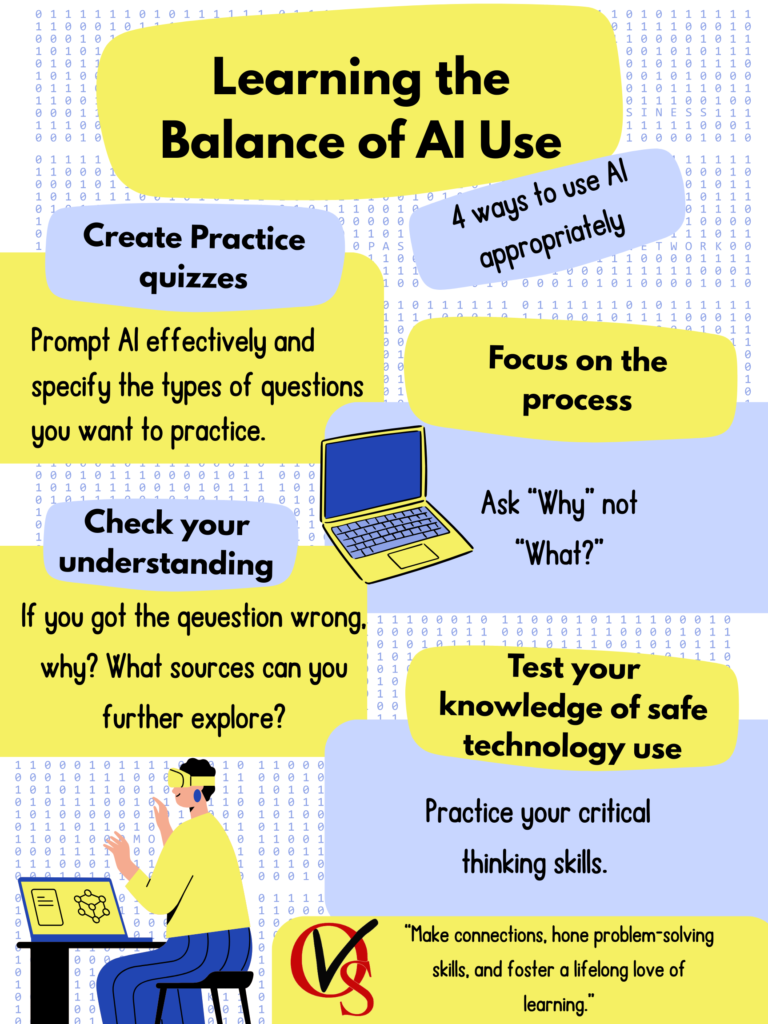
1. Create practice quizzes
AI may be new, but the old saying still rings true – practice makes perfect! OVS course material is always the first place students should turn to for practice as it is instructor generated, and accurately reflects course material. However, you can never have too many practice questions and AI will never run out of question ideas that you can be tested with. There are some important tricks to ensure that you are effectively generating prompts that relate to your course material. Review these tips before using AI to generate practice quizzes!
- Prompt AI effectively by specifying the learning targets
- OVS is an accredited online high school in Ontario, accredited by the Ontario Ministry of Education to give Ontario Secondary School Diplomas (OSSD). Our course material therefore reflects the Ontario curriculum which speaks to our high university acceptance rate after students graduate from our online high school, and succeed in future courses and careers. The learning targets that are reflected at the beginning of each lesson should be used as guiding prompts for AI when making practice quizzes. For example, a student taking Grade 12 Advanced Functions (MHF4U) may include in their prompt “to ensure I can determine the exact values of primary trigonometric ratios and reciprocal trigonometric ratios for special angles…”.
- Specify the type of questions you want to be asked
- Variety in your learning is vital to expanding your knowledge about a specific topic. Throughout your OVS course, you will practice with diverse questions and assignment formats (this is one of the many things that makes our online high school so effective). This variation equips students with mastery and critical thinking for the complex problems they will face outside of school. Taking this into consideration when creating practice quizzes is therefore vital when reflecting on whether you understand the course content. A student in CHY4U (World History Grade 12) should therefore ask for short answer questions, long answer questions as well as multiple choice. Furthermore, specifying the type of knowledge, including critical thinking versus facts will ensure you are getting the most of your practice with AI.
2. Focus on the process
Ask your tools “Why?” not “What?”. Using AI should never be about the final product. This leads to plagiarizing assignments. AI should instead be used as a tool in the process of learning. While completing course material you can use AI tools to deeper explain course material or topics. However, it is important that you are doing this correctly. Ask your platform to provide external links from where it retrieved the information (apply this tip to all the tips within this blog). This ensures that the information you are being given is credible (free of error, bias, and is reliable information). To further use AI in the process of learning, you can check to see how certain information can be used within careers. This helps students to better see the application of the course material, which will also translate into doing better on assignments. For example, a student in BOH4M (Grade 12 Business Leadership) might ask AI “I can see the application of the Scalar Chain Principle in jobs, but what would the application of the Myers Briggs Personality Test be?”
Remember that your questions in your OVS courses are encouraged to be directed towards your instructor, first and foremost. Our Ontario College of Teacher certified instructors are passionate about their course material, and will respond to emails within 24 hours. AI can be used when you are “in a flow” with your study block, and this information can be verified by your instructor afterwards.
3. Check your understanding
When you’re engaged in your material, you naturally begin thinking about the application of course content. Using AI to check your understanding is a great tool. These platforms may also lead you to more avenues of thought, which you can analyze and think about independently which will improve your own critical thinking. AI can also help expand why your answer to a response was incorrect, laying out the steps that should have been taken to arrive at the correct response. AI can then be prompted to provide more reliable links to resources that can further expand on the topic.
4. Test your knowledge of safe technology use
Albert Einstein states “The measure of intelligence is the ability for change”. This change in technology means that students need to reshape how they use technology to complete assignments. As mentioned previously, ignoring the rise of AI completely may lead to a misunderstanding of these platforms, as well as decreased confidence with these platforms, which can lead to not recognizing when material is AI generated, and could be unreliable. Interaction with AI tools allows students to practice their own critical thinking skills and to gain insight into how the platforms work. Using AI shows students that information provided from countless platforms could generate unreliable answers (not all the platforms it draws from are reliable). Furthermore, AI learns from the user’s input, which can lead to biases. Parental involvement in online school may therefore focus on critically thinking and discussing AI use and reliability, and the importance of not relying on AI first and foremost for courses.
Building literacy around AI use has become imperative to creating students who are prepared to enter the community. Online high school student success can be attributed partially to their digital literacy, including their digital literacy with AI. OVS opens conversations with students, informing them of the appropriate uses of AI to ensure they are receiving the best education possible. Our courses encourage critical thinking, not only surrounding curriculum, but in life skills that students will take with them beyond virtual high school. To finish high school online in Ontario means being equipped with not only course content, but also a sense of confidence when navigating this changing world. Explore Ontario Virtual School to achieve an education rooted in real world application.
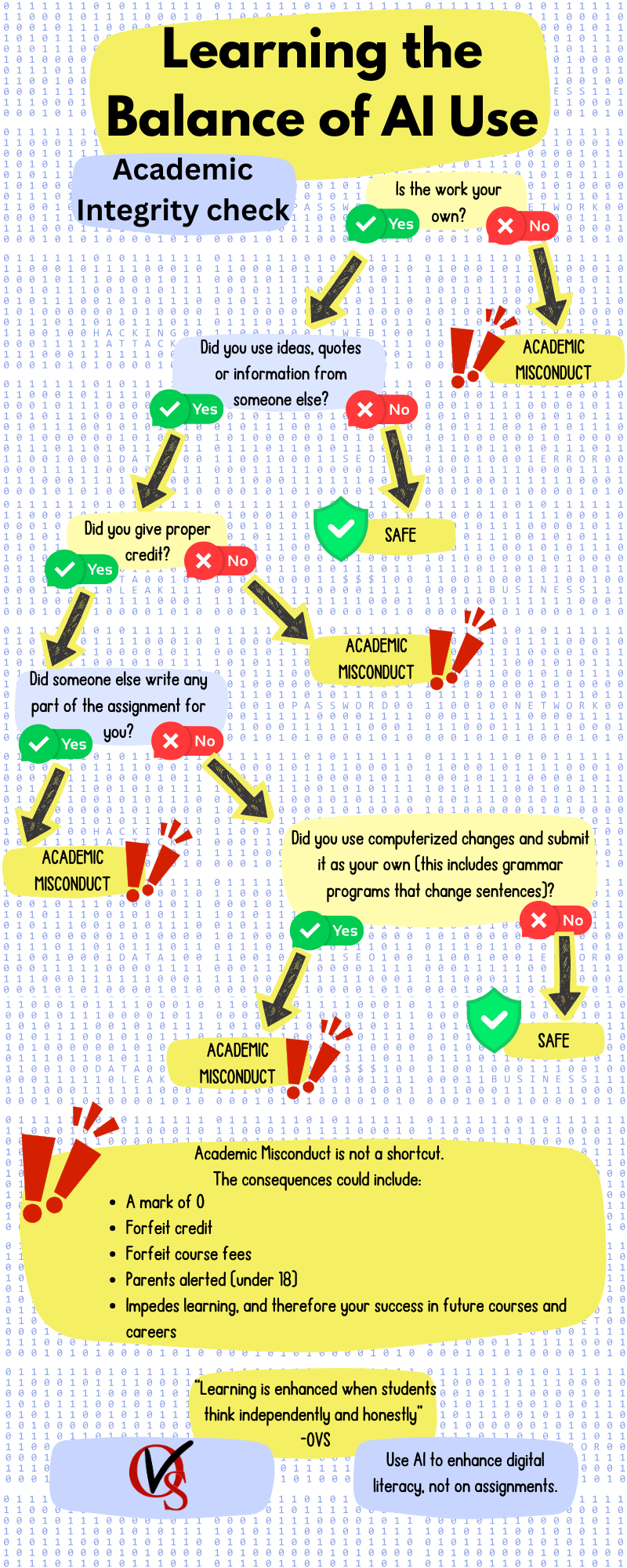
Question and Answer:
Q: Why is avoiding AI entirely not recommended for students?
A: Because AI is increasingly used in society, and students need to learn how to use it responsibly rather than ignore it.
Q: How can AI be used appropriately to support studying?
A: Students can use AI to create practice quizzes, check their understanding, and deepen explanations of course material.
Q: What is one key strategy for creating effective AI-generated practice quizzes?
A: Clearly specify the learning targets and the type of questions needed (e.g., multiple choice, short answer, critical thinking).
Q: Why should there be an emphasis on the process rather than the final product when using AI?
A: Because using AI for final answers (product) can lead to plagiarism, while using it for explanations and reasoning supports real learning. Focusing on the process (learning the material) will better equip you for future courses and applying the knowledge you learned.
Q: What risk is associated with relying too heavily on AI-generated information?
A: AI can provide biased or unreliable information, so students must verify sources and use critical thinking. Students also need to practice course material and critical thinking skills so they can grow as a learner.
Sources:
BBC News. (2025). What is AI, how does it work, and why are there concerns? BBC. https://www.bbc.com/news/articles/c2l799gxjjpo
Mollick, E., Mollick, L. (2023). Assigning AI: Seven Approaches for Students with Prompts. SSRN. Western University. file:///Users/katevanhezewyk/Downloads/ssrn-4475995.pdf
Written by Katelyn Van Hezewyk (OVS Teacher)