
Your Key to Success: Digital Citizenship
Why your school should teach digital citizenship
Upon graduating high school, teachers are not only equipping students to earn an Ontario Secondary School Diploma (OSSD), but also to develop a range of skills that will guide them beyond their virtual high school online courses. As technology continues to shape how we learn, work and interact, many of these essential skills are connected to technology use. Whether it is using technology to enhance learning, or understanding how to use it responsibly, digital citizenship has become imperative to student success.
Digital citizenship refers to the responsible use of technology, and to applying this knowledge beyond online spaces into their broader communities. Because technology is so intertwined in our communities, even responsibility in offline actions is considered digital citizenship. Students’ online behavior often reflects and affects their actions within their communities. This interconnectedness makes digital citizenship more important now than ever. Finding programs, like Ontario Virtual School, that intentionally teach digital literacy is important to your education journey.
What does Digital Citizenship Entail?
Digital citizenship involves responsible technology use and is made of several key components, including those listed below. What are your responses to the questions?
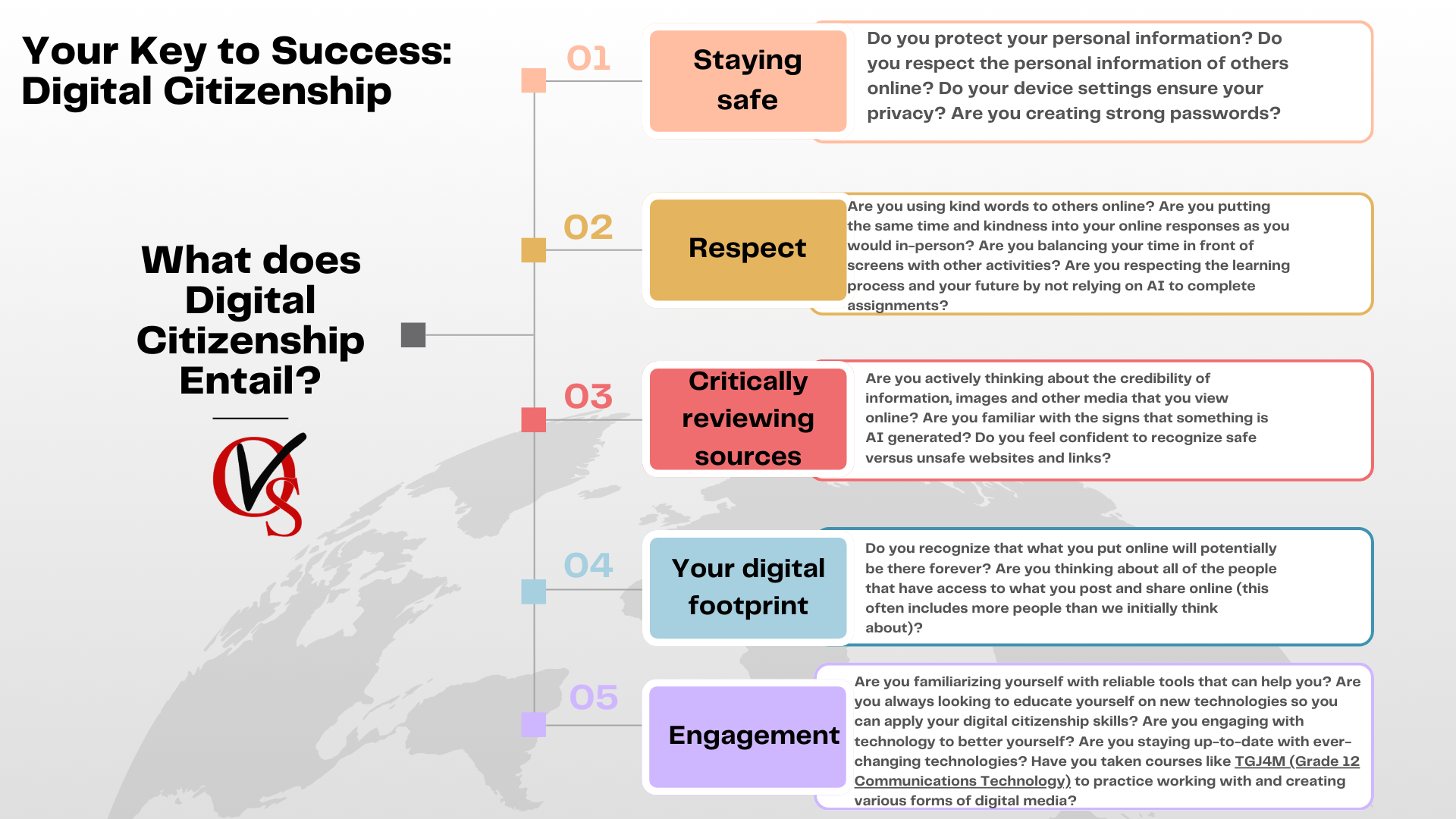
- Staying safe → Do you protect your personal information? Do you respect the personal information of others online? Do your device settings ensure your privacy? Are you creating strong passwords?
- Respect → Are you using kind words to others online? Are you putting the same time and kindness into your online responses as you would in-person? Are you balancing your time in front of screens with other activities? Are you respecting the learning process and your future by not relying on AI to complete assignments?
- Critically reviewing sources → Are you actively thinking about the credibility of information, images and other media that you view online? Are you familiar with the signs that something is AI generated? Do you feel confident to recognize safe versus unsafe websites and links?
- Your digital footprint → Do you recognize that what you put online will potentially be there forever? Are you thinking about all of the people that have access to what you post and share online (this often includes more people than we initially think about)?
- Engagement → Are you familiarizing yourself with reliable tools that can help you? Are you always looking to educate yourself on new technologies so you can apply your digital citizenship skills? Are you engaging with technology to better yourself? Are you staying up-to-date with ever-changing technologies? Have you taken courses like TGJ4M (Grade 12 Communications Technology) to practice working with and creating various forms of digital media?
How Digital Citizenship is Built
Learning begins at home and digital literacy is no exception. In a study by Lenhart, Madden and Smith (2011), 58% of students say that their parents are the biggest influence on their digital citizenship. Parents and guardians model digital behaviors without realizing that these habits will be transferred to their children. The ways that adults discuss, evaluate, and interact with online content significantly influences a child’s understanding of digital responsibility.
It is important not only for parents to recognize this, but for students to reflect on this as well. Think about how digital citizenship was modelled in your home, and what you can further expand on in class, the next place most students learn about digital literacy. Digital literacy can be embedded explicitly into course content, or intertwined into the completion of curriculum. At OVS, digital literacy is embedded in courses in several ways:

- Engaging with technology and providing resources
- Throughout their education with OVS, students are encouraged to use a variety of reliable and secure platforms. Becoming familiar with trusted tools will show students the signs of safe platforms, and will build their confidence with various forms of technology, which they will use in future workplaces. Our team of dedicated staff is always there to support students with not only course material and future plans, but with technology use as well.
- Modelling safe technology practices
- Encouraging critical thinking
- Critical thinking is a vital skill that needs to be taught and practiced. At OVS, critical thinking is embedded into all assignments. This allows students to practice this skill in a safe environment, preparing them for when they need it to make decisions surrounding their safety online.
- Providing free digital literacy training!
- OVS30 (Fostering Digital Literacy) is a free course offered by OVS to help students develop netiquette, develop critical thinking skills when checking internet validity, and understand plagiarism prevention (helping students develop and put into practice digital literacy).
The Power of Digital Literacy
Strong digital literacy skills have the power to transform how individuals interact with technology each day, influence the conversations you have, and even shape the careers they obtain. Because technology has become so intertwined in our lives, the conversations we have often involve technological components. How confidently and thoughtfully students engage in these conversations is directly tied to their digital literacy skills. Courses like ENG4U (Grade 12 English) develop these communication and critical thinking skills that become important to these conversations.
Staying informed about emerging technologies can also open doors to new opportunities, such as careers. Courses like ISC4U (Grade 12 Computer Science) give students the confidence to partake in conversations and jobs surrounding technology.
Staying up to Date, even with Rapid Changes
Finding educational programs that emphasize safe, current and meaningful technology is vital to improving digital literacy. Education institutions should emphasize using technology to enhance learning while preparing students for fields where critical thinking and various platform fluencies are essential.
OVS uses a variety of innovative platforms to provide students with a high-quality education to prepare them to become digital citizens. Students have opportunities to use tools such as Interactive Gizmos to apply not only course material, but the critical thinking skills that are deeply ingrained in digital literacy. The integration of digital literacy across our courses is a key advantage of virtual learning that sets OVS apart. Head over to Ontario Virtual School’s website to learn more about how we equip students with the digital literacy skills they need to succeed.
Questions and Answers:
Q: What is digital citizenship?
A: Digital citizenship is the responsible use of technology, both online and offline, and applying these skills within the wider community.
Q: Why is digital citizenship important for student success?
A: Because technology shapes how students learn, work, and interact, making responsible and informed technology use essential beyond high school.
Q: Who are the biggest influences on a student’s digital citizenship?
A: Parents and guardians, as they model digital behaviors at home as well as schools.
Q: How does Ontario Virtual School support digital literacy?
A: By embedding digital literacy into courses, modelling safe technology practices, encouraging critical thinking, and offering a free digital literacy course (OVS30).
Sources:
Lenhart, A., Madden, M., Smith, A., Purcell,K., & Zickuhr, K. (2011). Part 2: Social Media and Digital Citizenship: What teens experience and how they behave on social network sites. Pew Research Centre. https://www.pewresearch.org/internet/2011/11/09/part-2-social-media-and-digital-citizenship-what-teens-experience-and-how-they-behave-on-social-network-sites/
Written by Katelyn Van Hezewyk (OVS Teacher)