
Growing up, books were often described as life-changing tools. In elementary school, we’re taught that reading is a superpower that unlocks the world. In high school, we’re given knowledge through books and told they will prepare us for adulthood. As a teacher (and a bookworm), I strongly believe in the power of reading. Recently, I read the book 100 Ways to Change Your Life by Liz Moody, and was struck by how many of the tips could directly support students at Ontario Virtual School (OVS).
Self-growth relies heavily on motivation, but motivation isn’t always easy to maintain. Online high school success also requires discipline. The tools in this book can help you build strong habits that lead to success in your studies at OVS, setting you up for future success.
Reading 100 Ways to Change Your Life reminded me that online learning study habits don’t always have to be school specific. These habits are just smart strategies for life, and they apply perfectly to Ontario Virtual School online courses. These habits will help you build life skills that extend far beyond your current courses. Whether it’s Grade 12 Business Leadership course (BOH4M), Grade 12 Physics (SPH4U) or any subject at OVS. While the book has 100 tips that can be used to help you along your journey of self growth, I have compiled a few that I believe will positively impact your online high school experience.
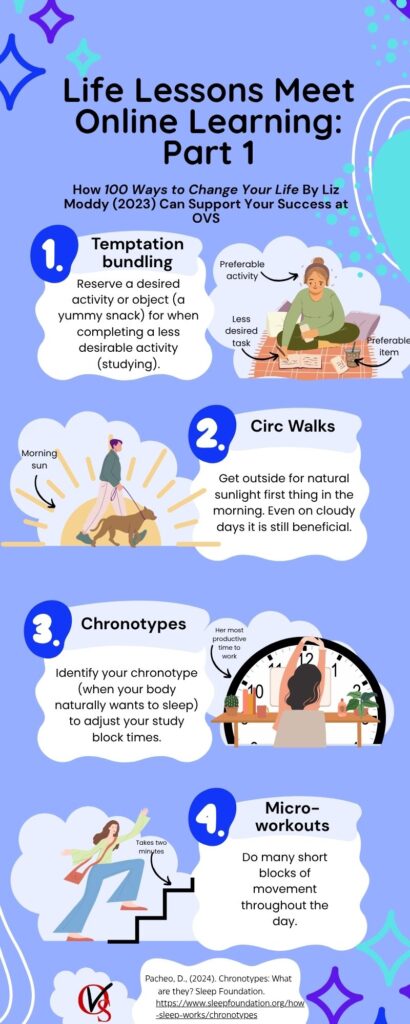
1. Temptation bundling (Chapter 8)
Temptation bundling, named by Dr. Katy Milkman, involves “reserving your temptation” for when you are tackling an undesirable activity (Moody, 2023, p.29). This builds an association between the desired activity, and the task that you’ve been putting off (just like our students in Introduction to Anthropology, Sociology and Psychology [HSP3U] learn)! This tool is especially helpful for those looking to complete high school faster. Temptation bundling “increases the rate at which people achieve their goals” (Moody, 2023, p.29). When you have a timeline in your mind that you are looking to follow, but can’t motivate yourself to start the assignment, reserve your favorite snack or a cool iced coffee for study sessions.
2. Circ walks (Chapter 9)
As a teacher, I am a big advocate for brain breaks and outdoor time. Reading 100 Ways to Change Your Life shows how we can take our brain breaks to the next level. Circ walks are like a pre-brain break.They help kickstart your day by regulating your circadian rhythms through early sunlight exposure (Moody, 2023). Ideally, take your circ walk first thing in the morning. Natural light is key, but the movement adds extra benefits. Before you even open your books, get outside in the sun and take a moment for yourself. The light will wake up your brain, making it easier to stay focused. Even if it is cold, or cloudy, you can still derive benefits from the morning sun!
3. Chronotypes (Chapter 11)
A chronotype describes your body’s natural tendencies towards sleep and productivity throughout the day (Pacheco, 2024). In other words, are you an early bird or a night owl? This is important when considering online high school student life. Recognizing your chronotype also allows you to recognize at what hours of the day you are most productive. Some researchers go further into this topic, labelling 4 chronotypes:
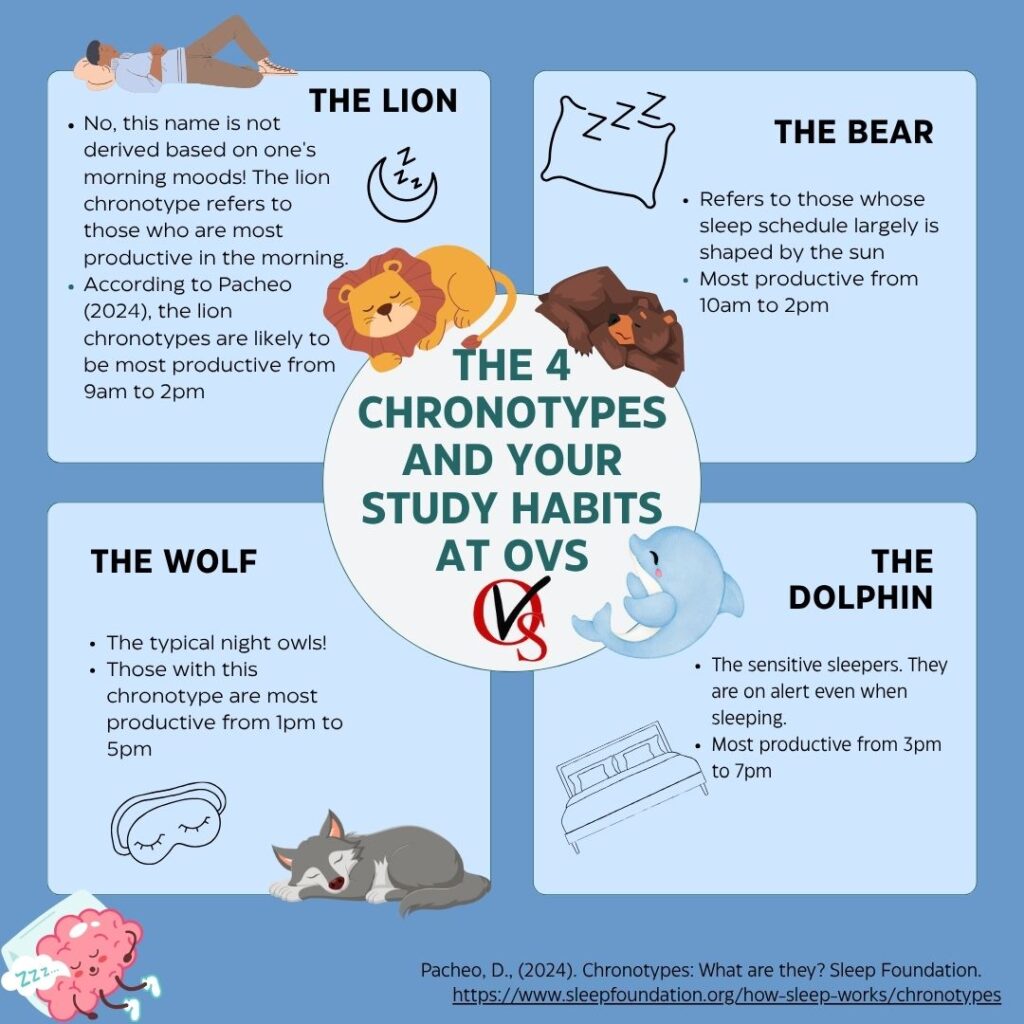
- The lion
- No, this name is not derived based on one’s morning moods! The lion chronotype refers to those who are most productive in the morning.
- According to Pacheco (2024), the lion chronotypes are likely to be most productive from 9am to 2pm
- The bear
- Refers to those whose sleep schedule largely is shaped by the sun
- Most productive from 10am to 2pm
- The wolf
- The typical night owls!
- Those with this chronotype are most productive from 1pm to 5pm
- The dolphin
- The sensitive sleepers. They are on alert even when sleeping.
- Most productive from 3pm to 7pm
Understanding your chronotype is an effective way to work on time management skills for online students. Especially those who are full time online students who have a flexible high school schedule.
4. Micro-workouts (Chapter 14)
Micro-workouts are another great brain break which involves moving throughout the day for shorter periods of time. These short periods of movements throughout the day “increase the blood and energy flow in our brains” making it easier to concentrate on your work. Moody explains that these movements don’t have to be formal workouts – just everyday choices like taking the stairs or parking further away can boost brain power (2023).
100 Ways to Change you Life Can Support Your Online Learning Journey at OVS
While I’ve only highlighted a few of the 100 powerful strategies in this post, I highly recommend reading the full book and exploring how its insights can enhance your online learning experience. Our self-paced online high school gives you the flexibility to incorporate these habits into your experience. At OVS, we are here to support you not only through our curriculum, but through the habits and resources you gain along the way. Visit our “Blog” page to see the other resources and tips OVS has to offer!
Written by Katelyn van Hezewyk (OVS Teacher)
Sources:
Moody, L. (2023). 100 ways to change your life: The science of leveling up health, happiness, relationships & success. Harper Wave.
Pacheo, D., (2024). Chronotypes: What are they? Sleep Foundation. https://www.sleepfoundation.org/how-sleep-works/chronotypes