
If you’re new to taking senior science classes, like SCH4U, SBI4U, or SPH4U, you may not be familiar with how to write a lab report. Classes like Grade 12 Biology require lab reports for each unit, so it’s important that students know what to include and what to leave out.
Title page
To start with, your lab report should have a title page with an informative title, your name, the course code, your teacher’s name, and the date. It may also be helpful to include the unit number for the course. For example:
The Effects of Sunlight on the Transpiration Rates
of Dieffenbachia Plants
John Smith
SBI4U: Unit 4
Ms. Miller
August 8, 2025
Coming up with a Title
It can be challenging to come up with a good title for assignments, and many students resort to simply calling it “Unit 3 Lab” or “Plant Lab”. These titles are not the most effective because they don’t tell the reader what the lab is about or what is being tested. A good example of a title would be “The Effects of Sunlight on the Transpiration Rates of Dieffenbachia Plants”. This is a good title because it tells the reader what is being measured (the transpiration rates), what variable is being manipulated (the amount of sunlight) and which species is being tested (Dieffenbachia plant). McGill University also outlines a what makes a good title in their blog post.
Introduction
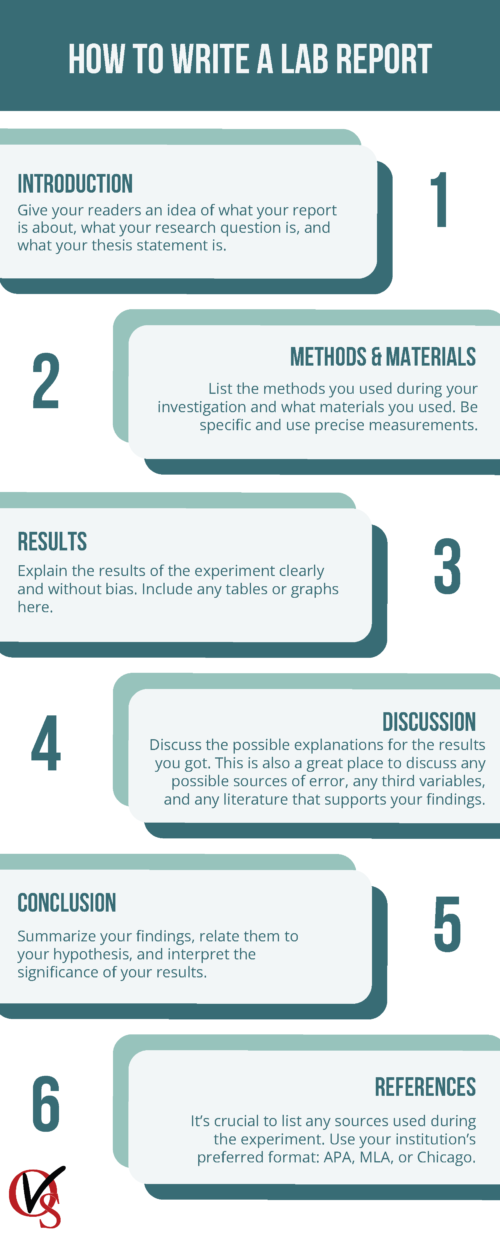
The introduction is where you should let your readers know what the lab report is about. Your introduction should include:
- any background knowledge or research that may be important
- key concepts and important terminology
- what the purpose of the experiment is
- your thesis statement
- You may also make predictions and explain why you expected to see certain results.
Trent University outlines in more detail what to include in an introduction in this blog post.
Methods and Materials
The methods and materials section (also sometimes called “procedures”) is where you will explain to your reader what you did and how you did it. It’s important to be very precise, giving exact measurements, equipment, and methods in order for other people to potentially recreate the experiment in the future. Some examples of things to include are:
- Measurements of liquids
- Observation times
- Temperature of the environment
- Dates and times of observations
- Equipment used (microscope, centrifuge, petri dishes, etc.)
- Organisms (species, sex, number, etc.)
- Any formulas used in calculations
- Control groups
Acadia University provides a more comprehensive list of things to include in this blog post.
Results
The results section is where you share the data you collected and the observations you made. This is where you will provide any tables or graphs, and you must be specific in what you observed. The data should be nicely organized and easy to read (such as in charts or graphs), and then you can go into more detail about what you observed in writing.
Discussion
The discussion is usually the longest section of the lab report. This is where you analyze your results in detail and relate it back to your thesis statement. You may want to discuss any variables that may have impacted the results and any sources of error. This is where literature and other research can support your findings and offer some kind of explanation. Draw a conclusion and confirm if it supports your thesis, does not support your thesis statement, or if it’s inconclusive. Vanderbilt University goes into more detail in this blog post.
Conclusion
In this section, you summarize your study, relate it back to your thesis statement, and discuss any gaps in the research. You may also relate it to similar studies and compare if your findings agree or disagree with those studies.
References
The references section is very important because you need to give credit to any literature you referenced in your lab report. You should use the preferred style of your institution, which may be either APA, MLA, or Chicago. If you aren’t sure how to format your citations or reference list, OWL Purdue is an excellent website to use for help.

This list is not concrete, as more extensive experiments will require more thorough reports, and many high school lab reports do not need to be this detailed. At the Ontario Virtual School, many labs are more informal, so if you aren’t sure, ask your teacher. Virtual high schools allow students to get quick feedback on their lab reports in order to improve their skills. OVS is a great place to practice formatting your lab reports properly so that you are prepared for university.
Q&A:
- Do all OVS lab reports have to be written in this format?
No, it depends on the grade, the class, and the teacher. Some are more informal – formatted like questions and answers – while others can be more extensive. If you’re unsure of how to format your lab report, ask your teacher.
2. Where should I include any charts and tables?
Charts and tables are generally placed in the results section because this is the data you collected from your experiment. If have a lot of data, it can be helpful to pick the most important charts and tables, and place the rest in an Appendix section at the end of the report.
3. How do I formulate a thesis statement?
A thesis is essentially an answer to your research question. It should be clear, concise, and state your position on the subject. For example, if your question is “Does sunlight increase or decrease the transpiration rate in Dieffenbachia plants?”, a good thesis statement would tell the reader what the researcher believes to be true. A good thesis statement might be “As sunlight exposure to Dieffenbachia plants increases, the transpiration rate also increases.” The results will then clearly either support or not support this statement.
Written by OVS teacher Michelle E. Miller