
While the rhythm of the traditional school year looks different across the globe, there are telltale signs in Ontario, Canada that the typical academic school year is drawing to a close. The days are getting longer. The weather is getting warmer. Summer vacation plans are on the horizon. But before students can fully embrace the dog days of summer, there are deadlines to be met, assignments to be submitted, and final assessments to be completed.
OVS Offers a Different Rhythm
One of the advantages of taking courses with Ontario Virtual School is that students have greater flexibility when it comes to timelines. Students who enrol in any of our courses, such as Gr. 12 English (ENG4U) or Gr. 12 Economics (CIA4U), have the option of completing courses in as little as 4 weeks or take up to 365 days, depending on their pace and schedule. What is more, the asynchronous platform affords students the flexibility of completing coursework from anywhere, at any time. Sometimes even the best laid plans are subject to unexpected events. So even if a student’s plan of finishing a course before summer vacation doesn’t work out, the option of extending their personal timeline is no big deal.
Finishing Strong
Although this flexibility is available to all OVS students, there are many students whose goals include finishing coursework within the timeframe of the traditional academic school year. That being said, getting through the last few weeks of school sometimes requires a renewed commitment to diligence and perseverance; of putting your head down, mustering up grit, and getting ‘er done, which is why the following suggestions may help students in finishing strong:
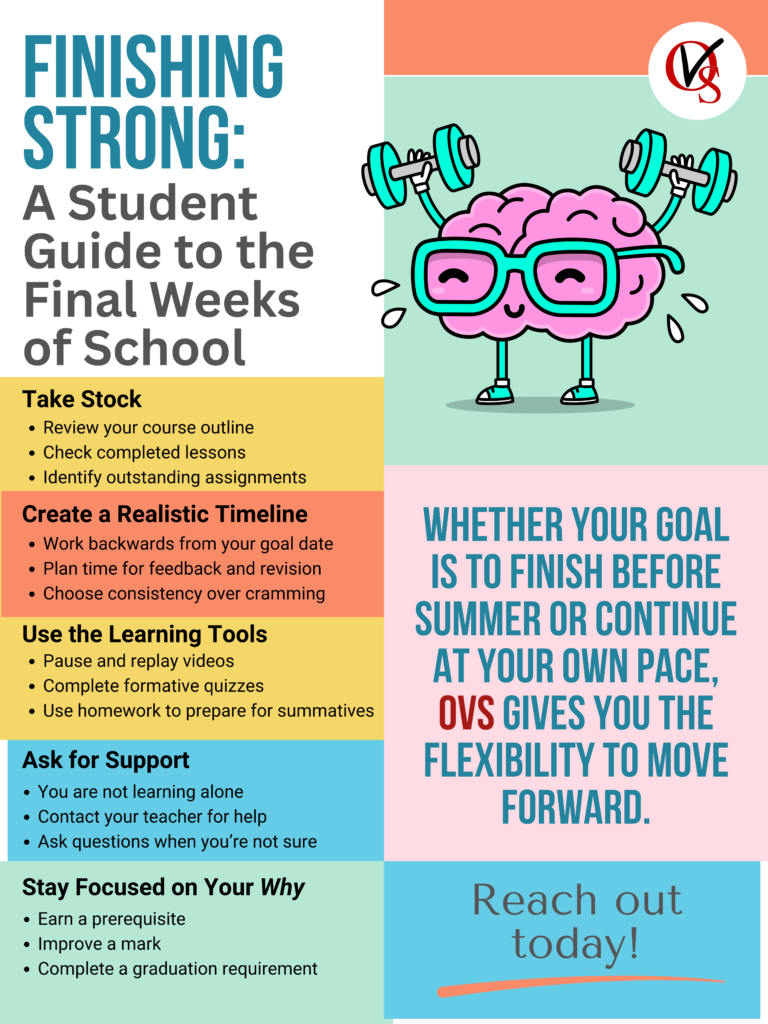
- Take stock of what still needs to be completed
Before creating a plan, students need a clear understanding of where they currently stand. This means reviewing the course outline, checking which lessons have been completed, identifying outstanding assignments, and noting any remaining tests, projects, or final evaluations. The OVS platform clearly identifies for students the total number of assignments in a course and the number that still need to be completed.
When trying to tackle these assignments, though, a vague goal like “I need to finish my course” can feel overwhelming. Students need to add more specific goals to their to-do list, such as “I have two lessons, one assignment, one unit test, and a final exam left to complete,” gives students a clearer path forward.
- Create a realistic timeline
Once students know what remains, they can work backwards from their desired completion date. Since OVS courses are self-paced, students have control over how quickly they move through the material. However, that control also comes with responsibility.
Students should consider how much time they realistically have each day or week to devote to their course. Accessing the Student Success Course Plan can help students build in time for teacher feedback, revision, studying, and final exam preparation. A realistic, consistent timeline is more effective than an overly ambitious one that leads to stress or burnout.
- Use the learning materials with purpose
OVS courses are designed to be more than text on a screen. Lessons include teacher-narrated presentations, multimedia features, simulations, formative quizzes, and homework opportunities to help students prepare for summative assessments.
As the end of the course approaches, it may be tempting to rush through lessons just to get them over with. However, students are more likely to be successful when they engage actively with the materials, take notes, pause and replay lesson videos when needed, and use formative quizzes as opportunities to check their understanding.
- Reach out for support when needed
One of the misconceptions about online learning is that students are working entirely on their own. At OVS, students can contact their highly qualified teacher for support throughout the course and can expect a response within 24 business hours.
Finishing strong does not mean doing everything independently. It means knowing when to ask questions, seek clarification, and use the support that is available. Whether a student is unsure about an assignment expectation or needs help understanding a concept, reaching out can make a meaningful difference.
- Stay focused on the goal
The final weeks of any course can be challenging. Motivation may dip, distractions may increase, and summer may feel just around the corner. This is the moment when students need to reconnect with their “why.”
For some students, the goal may be earning a prerequisite for post-secondary admission. For others, it may be improving a mark, completing a graduation requirement, or building confidence in a subject area. Whatever the reason, keeping that goal in mind can help students push through the final stretch.
Looking Ahead
Whether you’re already an OVS student who has a goal of finishing up coursework in the next few weeks or if you’re considering exploring a different rhythm to the traditional school year, OVS staff are always available for support and to answer questions. Explore OVS today!
|
Frequently Asked Questions 1. How quickly can students complete an OVS course? 2. Can students finish an OVS course before summer? 3. Are OVS students expected to work completely on their own? 4. What can students do if they feel overwhelmed near the end of a course? |
Written by Natalie Tayler (OVS Teacher)