
Burnout seems to be everywhere – in headlines, blogs and stories with titles and catch phrases scary enough to sound like movie trailers. As a student, it can feel like you’re the main character in a suspense film, standing in front of a door that you feel like you shouldn’t open. You worry that opening the door to completing high school faster, setting bigger goals or staying ambitious will unleash burnout and undo your efforts, but this isn’t how the story has to go. Burnout is real and serious, but it is not inevitable. With the right approach to your studies you don’t have to open the door to burnout to reach your academic goals.
A study by Chong, Foo, and Chua revealed that an astounding 70% of students experienced academic burnout (2025). With such a high rate, it is important that everyone be aware of the definition and signs of burnout before understanding how to avoid it. Burnout in academic areas is extremely negative feelings and even physical symptoms due to prolonged stress. This results in procrastination, decrease in performance, withdrawal and even an increase in colds, flus or other illnesses (Fei, 2023). Of course,the irony of all of this is that burnout can increase stress in the long run, creating a cycle that can be hard to escape.
While the rate of burnout is high among students, this does not mean that you are doomed to be caught in the burnout cycle. With Ontario Virtual School you can still fast track high school courses in Ontario and graduate stress free. Below are four tips to continue achieving your goals, while remaining happy and healthy in the process.
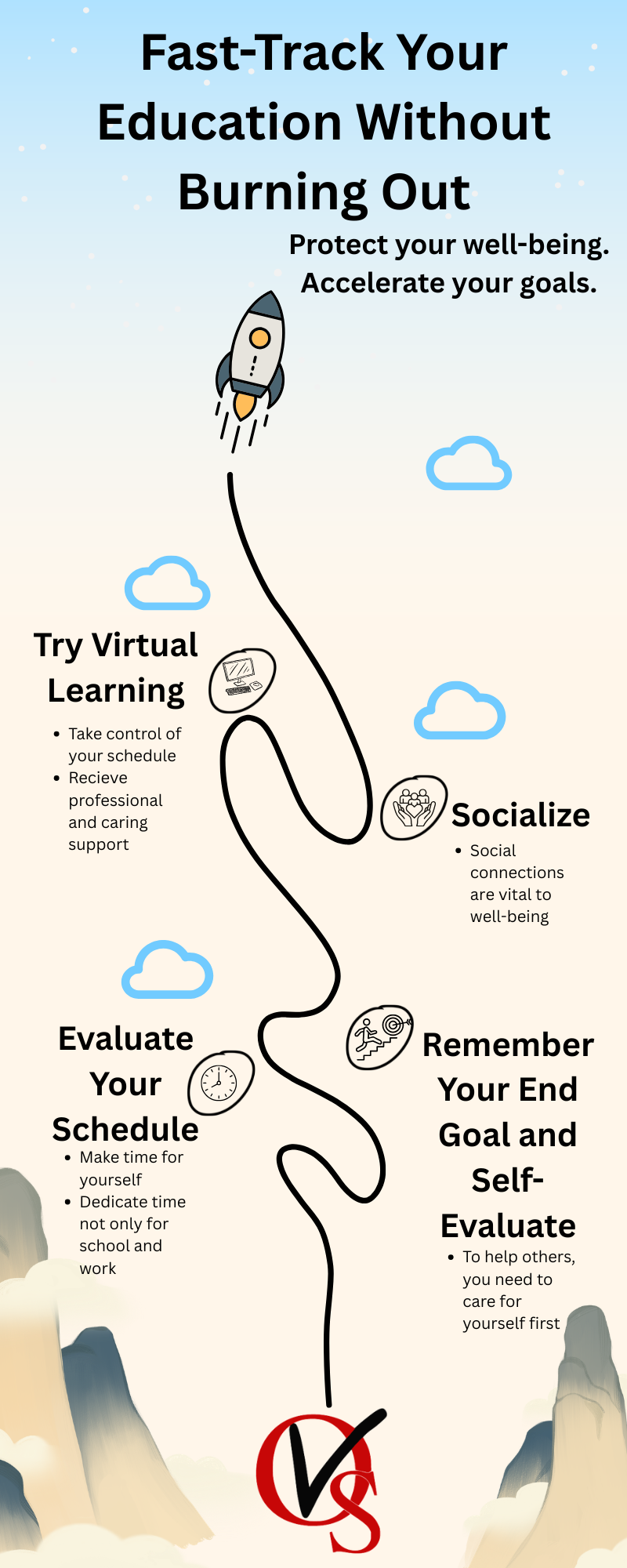
1. Try virtual learning
Burnout often develops when students are exposed to sustained academic pressure without sufficient flexibility or support. Contributing factors include studying or working constantly, taking on too many responsibilities, not feeling recognized for your hard work, not having accommodations met by learning facilities and lacking meaningful time with friends and family. There are countless advantages to virtual learning, including battling burnout. OVS can combat burnout in the following ways:
- Problem: Studying or working constantly
- Solution: In-person learning means that everything else happens from 5-9pm, and that’s just not enough time, especially considering students often come home with more homework. This leads to constant work, whether it be studying and/or a part-time job. A study by Gathgungun found that approximately 23952.5 minutes are lost in secondary public schools each year to transitions and alone (this number will vary between school locations). OVS allows you to schedule your own learning without 23,952.5 minutes of interruptions.
- Problem: Taking on too many responsibilities
- Solution: What other responsibilities can you tackle with those 23,952.5 minutes each year? 23,952.5 minutes is not insignificant. It represents valuable personal time, or for students working a part time job in Ontario, that is approximately $6,00 worth of work a year (depending on job, location, ect) that they can put towards their secondary education to reduce stress and balance their activities.
- Problem: Not being recognized for your hard work
- Solution: OVS takes pride in their student and faculty achievements. We love hearing all the fabulous things students are achieving outside of their academics and want others to recognize these achievements as well. Our Student Success Stories highlight the futures of our communities and the great things to come. On an individual level, our passionate OCT qualified educators are cheerleaders within the virtual learning environments. Providing feedback that not only improves, but motivates students can When looking between Ontario Virtual School versus homeschool, a structured virtual learning environment combines flexibility with qualified educator support. Furthermore, with online learning you can make more time to be surrounded by your friends and loved ones who cheer you on.
- Problem: Decreased social interactions
- Solution: Virtual learning allows students to better organize their schedule, finding more time to connect with those important to them. Making friends becomes easier in online high school when you have more time to connect with others. This reduces the risk of burnout and results in improved mental health.
- Problem: Not having accommodations met
- Solution: School can be overwhelming. With day schools having hard timelines for work to be turned in and a classroom full of students who learn differently, the pressure can creep up on students before they even realize it’s burnout. Schools that support students as unique learners alleviate stress by meeting students where they are at. This means no strict deadlines (so you can take the time you need in your Grade 12 Physics course [SPH4U]), varying learning assessments and tools and recognizing student IEPs to help them perform the best with minimal stress.
2. Socialize
Being burnt out often leads to withdrawing from social commitments, sometimes due to a sense of irritability or from falling into other unhealthy coping mechanisms (Owais, 2023). Recognizing this as a symptom of burnout allows students to ensure that they are making time for their relationships prior to experiencing burnout. The effects of being social span across your life in many ways, and it’s no surprise – we are built to be social, it’s biological (Smithsonian Institution, 2024). Our ancestors relied on social networks to grow communities, survive, and create the technology and lifestyle we have today, so yes, connections are vital to your own success as well. It takes a village! Your social life in online high school gives you perks that day school students may not get to experience. With an open schedule, you are not limited to 5-9pm on week nights and weekends. Furthermore, virtual learning provides you with the opportunity to meet peers at OVS events that you’ve all chosen to attend, like Canada Day celebrations at Chinguacousy Park!
3. Evaluate your schedule
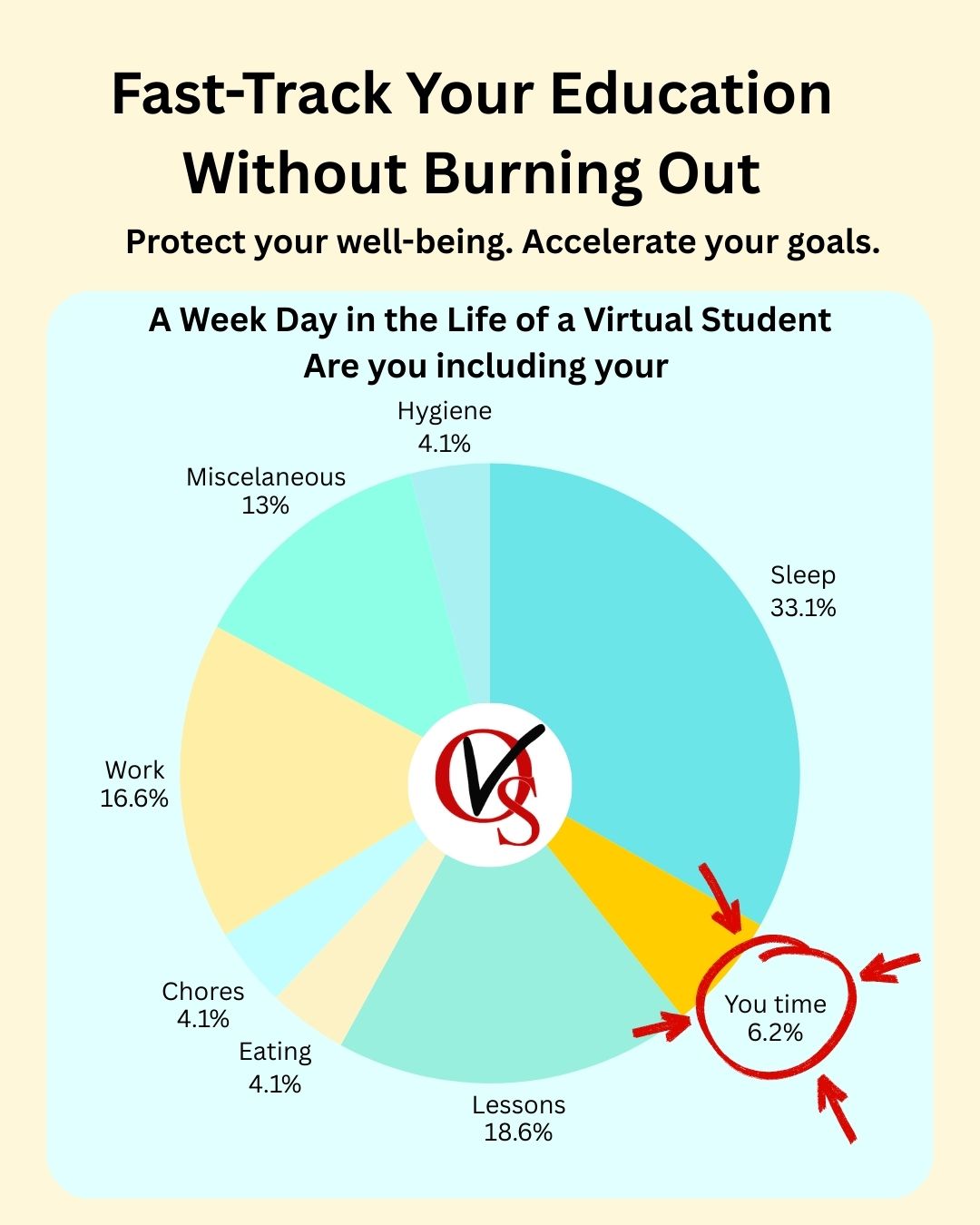
All work and no play makes Jack a dull boy. I’m sure you’ve heard that one before. It’s an expression that’s carried through generations because it’s true. Take a look at your weekly schedule. How much of your schedule is spent working (studying or employment)? How much time do you spend doing activities that you enjoy? While there is no set number of hours you should be dedicating to each, there does need to be a balance. Having balance will require you to make time for activities that you enjoy; if not, your schedule will fill up with responsibilities and that’s when the burnout will creep up on you.
Online high school student life with OVS makes scheduling activities that you enjoy easier by giving you freedom in your schedule. 10% of your day spent awake (yes, only 10%) is about 1 hour and 36 minutes. Aim to do an activity that you enjoy for at least 10% of your day. When you are enrolled in virtual school, this 10% can be at any time. When you notice that your attention is fading, spend 20 minutes walking. Then go back to your HHS4U (Families in Canada) with a fresh outlook on the material. If your job allows it, schedule the 10% into your day, and schedule your study time. When you are enrolled in OVS, the self-paced format helps you take control of your schedule, reducing the risk of burnout. Take back your 24 hour day with OVS.
4. Remember your end goal and self-evaluate
Your day-to-day habits are going to help you achieve your goal. These habits include those to battle burnout. There needs to be balance in your approach. Take burnout fighting habits day by day, ensuring that you are incorporating them into your routines, but remember your end goal. Yes, you want to be a doctor but more importantly, you want to help people. Put on your own air mask first as you would on a plane, then work towards the goal. The time to implement anti-burnout strategies is when you feel good. Start taking care of yourself before the signs of burnout appear.
You can graduate faster without burnout. The key is to make yourself a priority before you notice symptoms of burning out. Reach out to those around you for support in the process and surround yourself with people who care about you. Our staff is available to support you not only in your education journey, but with mental health as well. A supportive environment that prioritizes mental health and education is vital in preventing burnout as you reach your goals.
Frequently Asked Questions (FAQ)
Q: Can I fast-track high school without burning out?
A: Yes. Burnout is caused by prolonged stress—not ambition. A flexible, self-paced online high school in Ontario allows students to control their schedule, reduce transition time, and balance academics with personal life. Acceleration works when paired with structure and support.
Q: What are the main signs of academic burnout?
A: Common signs include:
- Chronic exhaustion
- Declining grades
- Procrastination
- Social withdrawal
- Increased illness
Early recognition prevents long-term stress cycles.
Q: Does online high school help reduce burnout?
A: It can. A structured virtual school reduces commute time, rigid scheduling, and daily transitions. With certified teacher support and flexible pacing, students can manage workload more effectively.
Q: How much downtime do students need to prevent burnout?
A: A practical target is 10% of waking hours — about 1 hour and 36 minutes per day. Scheduled recovery time improves focus and academic performance.
Q: Why is social connection important when fast-tracking school?
A: Social withdrawal increases burnout risk. Maintaining friendships and meaningful connections supports mental health, motivation, and long-term academic success.
Sources:
McMaster Student Wellness Centre. (2023, October 6). Beat the burnout. McMaster University. https://wellness.mcmaster.ca/beat-the-burnout/#:~:text=%E2%80%9CBurnout%20is%20a%20state%20of,only%20caused%20by%20academic%20stress.
University of Alberta. (2023, December 7). Dealing with burnout? You’re not alone. https://www.ualberta.ca/en/youalberta/2023/12/dealing-with-burnout-youre-not-alone.html
Smithsonian Institution. (2024). Social life. Smithsonian’s Human Origins Program. https://humanorigins.si.edu/human-characteristics/social-life
Written by Katelyn Van Hezewyk (OVS Teacher)